5/4/07
Baja Hwy 1
The challenge of forming a company in a foreign country where over half of the working population are civil employees supported by the fees, permits, registrations, and bribes of your tourist-based enterprise is taking its toll on both of us. Work up north is closing in from the other side. We leave our new Mexican partner with some alternatives to “just make it work for now and we’ll fix it right in November”, jump into the already packed Toyota Corolla and head out of Loreto just before sunset. Cue the dust, billowing backlit among cardon cacti as the car dwindles into the mountains. Pop in a tape that has “freedom” in the title of every song on it.
The immediacy and opportunity of the road infect our spirits with lightheartedness. We begin rebuilding positive momentum and the fundamental joy of simply being, and even being together.
Sunrise is a good start. We awake on Playa Escondida. A fat moon one day past full has marked time all flea-infested night and now waits over the western mountains. Under its light and the first blush of the coming sun I succumb to the desire to swim out to the nearest island in the glassy Sea of Cortez.
Leaving my towel and clothes just above the wet sand on the surf-softened shell fragments, I wade barefoot into the sea. It’s a little cool, but comfortable.
The surface of the water reflects the colors of the sky as they mature in to peachy orange and turquoise. I can see my hands extend in front of me under the diaphanous colors. The moon, too, floats behind a transparent curtain of water colors. Pink clouds waft across its bright face.
It feels good to move, stretch, loosen up after days of computer work, bending to pack, sitting in a car, and sleeping on a sloped beach. It feels particularly good to be gliding through the water as absolutely naked as I was born. No suit to billow in the water, no bulky mask to fog or grip my head. No fins to rub. Not even a hair band to keep the tresses from drifting across my back or under my arms on the crawl stroke. Just me and the sea and a brand new day.
I could see David walking the beach for interesting fragments from the sea or the indigenous people. It’s our new era—co-owning a Mexican company as a means to the dream of instructional sea kayak expeditions in Baja. Somehow the dreams are always cleaner than the work to birth them. If it were easy, would the accomplishment be so sweet? The challenge is to remain human and to stay in touch with the fundamental, simple pleasures of just being and being together in places that we love.
Tuesday, May 08, 2007
Thursday, March 29, 2007
Last Islands Trip
Was it an omen when we discovered on the first night that we’d forgotten to pack the coffee? What could be worse to forget, except perhaps toilet paper? Or maybe the prevailing omen was one of resourcefulness and kindness when David paddled the coffee out to us the next morning through the rare Sea of Cortez fog.
I didn’t think about it until almost the end of the trip, but if plans hold their course, this was my last Sea of Cortez Islands trip that I will lead for my employers of 8 years, Sea Kayak Adventures. On this route I have spent most of my last 8 winters, on the beaches of Carmen and Danzante Islands. My next trip is the La Paz 10-day, and that’s it for the season. Next season I hope to be busy with my own trips in new areas, and gently close the book on an era of paddling giant double kayak/barges and making extravagant meals. A change to look forward to while still feeling nostalgic, and a little nervous about braving the new. But at the beginning of this trip, its significance had not yet dawned on me.
When my well-coffee’d group finally launched into the fog later that morning to skirt Danzante Island, we were accompanied by a pod of dolphins. They passed directly beneath some of the kayaks. Leisurely we cruised together along the rocky coastline while mystery clouds poured into the creases between hills. Fog played hide and seek with silhouettes of odd desert plants on the ridges. Dolphins stuck their noses in the air to look around. Slapped the water with their tails. Circled back with apparent curiosity. The white darkness of fog moved behind us on the water, and sun bathed our happy aquatic procession.
One afternoon on southern Carmen Island we all hiked inland from Playa Blanca to see if we could find the fabled Indian well. There is a shell midden at the beach being eroded by recent storms, and a guest on my trip years ago found an arrowhead on the beach. An Indian well would make sense here. Except for the flat marine shelf we were on, and the proximity of the sea. Curiosity had all of us in its grip, so we followed the south rim of the arroyo naming, photographing, fondling and sniffing plants along the way. The arroyo below us was thick with foliage. Mesquite trees and giant torote reached up to the level of the rim. Palo verde clung onto the sides tenaciously.
A little barrel cactus torn by some torrent or wind clung to the rim’s sharp soil by one filamentous root. One of our party wanted to pick it up and “save” it, though she didn’t know what she would do with it, exactly. That instinct to give suffering things a hug.
We were a group more experienced in administering hugs than kayaking. Eight women in or near their 60s, woven together by threads of friendship and friends of friends, though none knew everybody. Plus one young couple and a middle-aged pair of fun-loving best friends. Derek from the couple and our guide Mario were the only men, but they managed. The eight women were all fit and spirited. Well versed in rolling with the surprises of life. Motherhood, grandparenting for many, travels around the globe. At least two had fought breast cancer and won. Several owned their own businesses, one donating much to cancer research. Now they were tackling the new challenges of a kayak camping trip with grace and humor. For some it was their first time in a kayak, ever. And it was the first time for all of them on an archeological expedition to find an Indian well on a desert island.
Mario walked ahead, and called my name. I left the pitied barrel cactus and those who wanted to hug it and followed the sound of his voice. At the top of the pouroff, just above what would be the waterfall had there been water running, and overhung by trees, was a hole about 4 ft around with fine gravel at the bottom. Decades or centuries after its creation, after untold storms had carried debris into it, it was still deep enough to hold significant water after a storm. Mario lowered himself in, marking the depth, scientifically, at one Mario and a half.
On the fifth day we awoke after a full night of westerlies that had been preceded by southerlies, and both Mario & I suspected north wind within the next days. We changed plans. After a morning hike and early lunch, we crossed to the protection of Punta Coyote. Except Punta Coyote was occupied, so we continued to Rattlesnake Beach with a fun 10 knot following sea. The mesquite-bordered campsite at Rattlesnake where my friends Dan & Heather stayed two years ago was vacant, as was the entire south end of the popular RV beach. So we landed and made ourselves at home. So many layers of memory and experience there for me. Klaus & Parvin’s newly vacant site was the next one, where Derek and Michelle pitched their tent. Bunny put up her tent in the subtle arroyo mouth where David & I slept out on the beach together for the first time. Where the Giggle Girls pitched among the mangle dulce bushes, I used to park my truck when I left on short personal trips, except the year Paul and Alisa were camped there.
As we set up the kitchen in Dan & Heathers site, I wrapped myself happily in blankets of warm memory. Somebody requested for Happy Hour entertainment on our final evening together that Joan and I do some voice & flute duets. I put my flute together and was trying to remove enough popcorn from my teeth to play when I turned to see 3 people entering the edge of the campsite. I waved, then recognized them. Scott and Cara. And Hans! The one responsible for introducing me to kayaking and Baja ten years ago. The one whose fault I was here at all. The inspiration for this life I lead. This is the moment when the soundtrack should do something dramatic. These vortices of energy and time and people just don’t do this except in fiction.
I visited Hans and Scott and Cara that night after my crew had fallen asleep. We retold old stories and caught up on news till the southern cross and scorpius came up. A new memory to snuggle into and smile when the cold wind blows.
The next morning, as planned, and just after coffee was ready, Joan and I faced the Sea of Cortez where Danzante Island’s silhouette glowed pregnant with a sun about to rise, and we harmonized Morning Has Broken. She and I, both recent breast cancer survivors, shared that bond and a general affection for each other. We became one energy for a moment in the music and the first glow of morning. The sun peeked up, a reflection widened on the water, sparkled, and everything came together on this last morning, to the soundtrack of voice and flute.
Thus a magical ending of an era, and a fitting beginning of the next.
I didn’t think about it until almost the end of the trip, but if plans hold their course, this was my last Sea of Cortez Islands trip that I will lead for my employers of 8 years, Sea Kayak Adventures. On this route I have spent most of my last 8 winters, on the beaches of Carmen and Danzante Islands. My next trip is the La Paz 10-day, and that’s it for the season. Next season I hope to be busy with my own trips in new areas, and gently close the book on an era of paddling giant double kayak/barges and making extravagant meals. A change to look forward to while still feeling nostalgic, and a little nervous about braving the new. But at the beginning of this trip, its significance had not yet dawned on me.
When my well-coffee’d group finally launched into the fog later that morning to skirt Danzante Island, we were accompanied by a pod of dolphins. They passed directly beneath some of the kayaks. Leisurely we cruised together along the rocky coastline while mystery clouds poured into the creases between hills. Fog played hide and seek with silhouettes of odd desert plants on the ridges. Dolphins stuck their noses in the air to look around. Slapped the water with their tails. Circled back with apparent curiosity. The white darkness of fog moved behind us on the water, and sun bathed our happy aquatic procession.
One afternoon on southern Carmen Island we all hiked inland from Playa Blanca to see if we could find the fabled Indian well. There is a shell midden at the beach being eroded by recent storms, and a guest on my trip years ago found an arrowhead on the beach. An Indian well would make sense here. Except for the flat marine shelf we were on, and the proximity of the sea. Curiosity had all of us in its grip, so we followed the south rim of the arroyo naming, photographing, fondling and sniffing plants along the way. The arroyo below us was thick with foliage. Mesquite trees and giant torote reached up to the level of the rim. Palo verde clung onto the sides tenaciously.
A little barrel cactus torn by some torrent or wind clung to the rim’s sharp soil by one filamentous root. One of our party wanted to pick it up and “save” it, though she didn’t know what she would do with it, exactly. That instinct to give suffering things a hug.
We were a group more experienced in administering hugs than kayaking. Eight women in or near their 60s, woven together by threads of friendship and friends of friends, though none knew everybody. Plus one young couple and a middle-aged pair of fun-loving best friends. Derek from the couple and our guide Mario were the only men, but they managed. The eight women were all fit and spirited. Well versed in rolling with the surprises of life. Motherhood, grandparenting for many, travels around the globe. At least two had fought breast cancer and won. Several owned their own businesses, one donating much to cancer research. Now they were tackling the new challenges of a kayak camping trip with grace and humor. For some it was their first time in a kayak, ever. And it was the first time for all of them on an archeological expedition to find an Indian well on a desert island.
Mario walked ahead, and called my name. I left the pitied barrel cactus and those who wanted to hug it and followed the sound of his voice. At the top of the pouroff, just above what would be the waterfall had there been water running, and overhung by trees, was a hole about 4 ft around with fine gravel at the bottom. Decades or centuries after its creation, after untold storms had carried debris into it, it was still deep enough to hold significant water after a storm. Mario lowered himself in, marking the depth, scientifically, at one Mario and a half.
On the fifth day we awoke after a full night of westerlies that had been preceded by southerlies, and both Mario & I suspected north wind within the next days. We changed plans. After a morning hike and early lunch, we crossed to the protection of Punta Coyote. Except Punta Coyote was occupied, so we continued to Rattlesnake Beach with a fun 10 knot following sea. The mesquite-bordered campsite at Rattlesnake where my friends Dan & Heather stayed two years ago was vacant, as was the entire south end of the popular RV beach. So we landed and made ourselves at home. So many layers of memory and experience there for me. Klaus & Parvin’s newly vacant site was the next one, where Derek and Michelle pitched their tent. Bunny put up her tent in the subtle arroyo mouth where David & I slept out on the beach together for the first time. Where the Giggle Girls pitched among the mangle dulce bushes, I used to park my truck when I left on short personal trips, except the year Paul and Alisa were camped there.
As we set up the kitchen in Dan & Heathers site, I wrapped myself happily in blankets of warm memory. Somebody requested for Happy Hour entertainment on our final evening together that Joan and I do some voice & flute duets. I put my flute together and was trying to remove enough popcorn from my teeth to play when I turned to see 3 people entering the edge of the campsite. I waved, then recognized them. Scott and Cara. And Hans! The one responsible for introducing me to kayaking and Baja ten years ago. The one whose fault I was here at all. The inspiration for this life I lead. This is the moment when the soundtrack should do something dramatic. These vortices of energy and time and people just don’t do this except in fiction.
I visited Hans and Scott and Cara that night after my crew had fallen asleep. We retold old stories and caught up on news till the southern cross and scorpius came up. A new memory to snuggle into and smile when the cold wind blows.
The next morning, as planned, and just after coffee was ready, Joan and I faced the Sea of Cortez where Danzante Island’s silhouette glowed pregnant with a sun about to rise, and we harmonized Morning Has Broken. She and I, both recent breast cancer survivors, shared that bond and a general affection for each other. We became one energy for a moment in the music and the first glow of morning. The sun peeked up, a reflection widened on the water, sparkled, and everything came together on this last morning, to the soundtrack of voice and flute.
Thus a magical ending of an era, and a fitting beginning of the next.

Monday, March 05, 2007
Saved by a Leaky Boat
The trips began as most do, obediently following its itinerary. Then the wind picked up. This was a group with itchy feet, not wanting to sit on the beach, but preferring to challenge the wind. So, figuring we could always get back to Punta Coyote from Rattlesnake Beach, we cruised a mile downwind to walk a storm-scoured arroyo. The short paddle was in an area relatively protected by the hills of Puerto Escondido.
The excitement began when we launched to return. Digging into the wind was tougher than people expected, and after half an hour we’d put only a few hundred yards behind us. Some people were wearing down, and periodically somebody would lose their angle into the wind and struggle to turn back into it. I towed two doubles from the back of the group to the front, and looking at the big picture, decided it was time to surrender and take the group into the beach. Walking the kayaks up the beach was our pre-discussed back-up plan. The situation would be easier to control, and risks greatly reduced if we walked the kayaks up to the headland, then paddled the short, more protected crossing.
One guy in particular was upset and wanted to continue paddling, but the majority was relieved and saw the sense in it. Dan thought I was singling him out to go to the beach as a punishment for something since I sent him and his wife and their friends Chris and Regina in first, but they happened to be closest, and among the strongest, and I figured they could help others land if they were on shore. Discussion in the wind was not an option; it was one of those rare times for orders. He didn’t hesitate, but he sure got a lot of mileage out of grumbling about it afterwards!
All landed safely, we regrouped, briefed on safe walking of kayaks along the shore—keeping boat between self and shore, and not passing anyone in the line and in so doing putting them at risk of your kayak hitting them. Slowly, the parade progressed to the end of the beach, where a fateful green panga waited. A panga is an oversized rowboat with a motor used for fishing, tourism, and pretty much everything in Baja. Pangas are usually white with blue gunwales, but this one was painted green on the outside.
One gal was so pooped she wanted a hotel. No more wind, no more beach camping, no more paddling. So there were the 2 extremes: one wanted to keep paddling, and one wanted to go home. Friends of both told me later that they are just that way—one flighty and tried to cancel trip twice before it even began, and one (from New Jersey—I should make allowances) always challenging the “rules”. He was the one most often asked to put his shoes back on.
There we were in the wind, fifteen tired, hungry, paddlers facing a quarter mile more wind across the opening to Puerto Escondido. I was opening my mouth to organize a sheltered rest and gorp snack while the rest of my brain tackled the short crossing—partners to switch, strategies and angles… Lino caught me and said, “I know the guy who has that panga. We can find gas from someone on the beach, and take people to camp in the panga.”
I looked at the group, at the panga, and at the wind, and something clicked. To the group I announced, “We’re going to see if we can find gas for the panga while you rest.” A cheer went up. I suggested some places to sit out of the wind, and walked down the beach with Lino.
We chatted about options on the way. My raw left foot started to bleed from the rubbing of my sandal. Option one: We could haul the tired people in Panga, paddle the others, and then tow the kayaks. All that would take time and we’d be late for lunch with hungry tired people. I wasn’t sure about towing the kayaks—what damage we’d do in the wind. The trip was over the next day and we could get a pick-up right where the kayaks were if we wanted to keep the panga and ride out in the morning, which was option two. Or, option three, we could bring camp and lunch to the people where they sat on Rattlesnake beach. But there was no good place to camp where we were. And we did not want to retreat back down the beach to the open spaces and need to paddle back into the headwind again, with a forecast of stronger wind the next day.
Considering the forecast, the tiredness of the group, and all other factors, we decided on option two. Shuttle people, the rest of the food, and all loose gear back to camp in the panga in two shifts, and leave the kayaks in the care of the RVers “Honey Jim” and his wife, both kayakers themselves, and their Rottweiler dog. Back at camp there would be snorkeling opportunities and a single kayak to play with if people wanted in the afternoon.
I asked Lori to wait until after lunch to make a decision on leaving for a hotel. After lunch, Lori did still want a hotel if we could get a taxi and a ride out. We felt we needed to make one more trip back to the kayaks to close them up and tie them together just to feel better about leaving them, and we could take Lori and Glenda (who would go with Lori for support) to the ramp and call a taxi. We could also call SKA house to change our pickup location to Rattlesnake Beach. And make troops happy by bringing back some beer. This part was a secret.
The troops were crashed in their tents or sitting with a book or taking a relaxing walk along the coast. They were ready for some down time. We had challenged the conditions, and met our match. Spirits were generally good, except for grumbling Dan whom nobody took seriously anyway, least of all his wife who’d been in the front of his boat unable to open her eyes for the salt spray. Rest was welcome.
So Hilary held the beach front while I went with Lino and the girls, called a taxi, and walked with the girls to the beer store while we waited for the taxi. They said they’d had a great time, just were ready to sleep in a hotel and take a shower. One more night on the beach, they explained, couldn’t add any more to their experience. Sometimes I just don’t know what to believe about people!
There was beer at the store (which there hadn’t been the afternoon before when Lino and Jim paddled for it), and I sent beer, ice, and the girls in the taxi, which arrived as we reached the store, back to the ramp to deliver beer and pick up the girls’ stuff. I asked the taxi driver to take them to Hacienda Suites, but wait to make sure they had rooms there, or take them to a place with room availability.
Then I ran next door to the internet room to call for the Rattlesnake Beach pickup the next day, and began running back to the ramp. I hailed a passing VW van of yachters for a ride back, met Lino at the ramp, rode to Rattlesnake Beach to close and tie up the kayaks, then quickly back to the group on Punta Coyote. The afternoon jaunt was a mini-adventure involving a panga ride, walking, running, a taxi, and hitchhiking, all in the space of an hour and a half.
The New Jersey contingent of our group, up from their naps, was walking towards the lighthouse when we returned in the panga. We exchanged waves, then continued on to land at the beach, brought up the beer and ice, and got the lowdown on the walkers. Julie, one of our sprightly old ladies, had walked that way while the others napped. She came back reporting that she’d walked around to the side where the yachts anchored, and successfully begged a beer.
“Did you have to show your boobies?” one of the Jersey girls asked.
“Yeah, but you’ll do much better with yours because they’re young and perky,” Julie replied.
Upon hearing that report, the Jersey crew started their hike, wives in tow. That’s when we returned with our surprise cold beer for Julie, the big storyteller, to enjoy first while we laughed at the gullibility of the others and what they would do for a cold brew.
The next morning we panga’d people and gear out in three trips, the first of which I went on, helped unload gear, and rode back with Lino to facilitate the next trip. On the return, at his request, I sat up front to keep the bow down while Lino captained. The early morning sun gilded his straw hat, strap hooked under his brown chin. His full lips were relaxed but stoic, eyes obscured behind sunglasses--mirrors of the morning. Behind him the spray from our boat arched, our white trail stretched through the whitecaps, the red mountains rose impartial. Behind the last light blue bench seat Lino’s sandaled feet stood ankle deep or more in water that was geysering up from the thumb-sized hole and numerous pin-pricks in the bottom. As the captain steered with one hand, his face and manner intent on the horizon, the weather, the future, and all things pertinent to the sea and sky, his other hand scooped water and flung, scooped and flung with a homemade bleach-bottle bailer.
The juxtaposition of chaos and calm, all contained in the light blue interior of our vessel, a cradle in the storm with its dark blue gunwales somehow delineating this patch of peace in the midst of a storm, became not a juxtaposition at all, but a small perfect piece of a larger picture. It was a microcosm of our situation. The team of Lino, Hilary and myself, with the helpful hands of our guests, worked together to execute the ever evolving plan (Plan Q are we up to now?) Managing resources, people, and time, with the wind whipping around our heads and somehow a core of quiet from which we reach out to steer, look ahead, and bail the leaky rescue boat. A metaphor of life itself.
So that was the exciting ending to a memorable trip that also involved the capsize of a guide in a double on a crossing (and uneventful rescue), being followed by a film crew in an inflatable as we landed from that crossing, and seeing a 10’ shark from a hillside on the final morning’s hike. And people wonder how it doesn’t get boring after ten years of guiding here!
Paddle On!
Ginni
The excitement began when we launched to return. Digging into the wind was tougher than people expected, and after half an hour we’d put only a few hundred yards behind us. Some people were wearing down, and periodically somebody would lose their angle into the wind and struggle to turn back into it. I towed two doubles from the back of the group to the front, and looking at the big picture, decided it was time to surrender and take the group into the beach. Walking the kayaks up the beach was our pre-discussed back-up plan. The situation would be easier to control, and risks greatly reduced if we walked the kayaks up to the headland, then paddled the short, more protected crossing.
One guy in particular was upset and wanted to continue paddling, but the majority was relieved and saw the sense in it. Dan thought I was singling him out to go to the beach as a punishment for something since I sent him and his wife and their friends Chris and Regina in first, but they happened to be closest, and among the strongest, and I figured they could help others land if they were on shore. Discussion in the wind was not an option; it was one of those rare times for orders. He didn’t hesitate, but he sure got a lot of mileage out of grumbling about it afterwards!
All landed safely, we regrouped, briefed on safe walking of kayaks along the shore—keeping boat between self and shore, and not passing anyone in the line and in so doing putting them at risk of your kayak hitting them. Slowly, the parade progressed to the end of the beach, where a fateful green panga waited. A panga is an oversized rowboat with a motor used for fishing, tourism, and pretty much everything in Baja. Pangas are usually white with blue gunwales, but this one was painted green on the outside.
One gal was so pooped she wanted a hotel. No more wind, no more beach camping, no more paddling. So there were the 2 extremes: one wanted to keep paddling, and one wanted to go home. Friends of both told me later that they are just that way—one flighty and tried to cancel trip twice before it even began, and one (from New Jersey—I should make allowances) always challenging the “rules”. He was the one most often asked to put his shoes back on.
There we were in the wind, fifteen tired, hungry, paddlers facing a quarter mile more wind across the opening to Puerto Escondido. I was opening my mouth to organize a sheltered rest and gorp snack while the rest of my brain tackled the short crossing—partners to switch, strategies and angles… Lino caught me and said, “I know the guy who has that panga. We can find gas from someone on the beach, and take people to camp in the panga.”
I looked at the group, at the panga, and at the wind, and something clicked. To the group I announced, “We’re going to see if we can find gas for the panga while you rest.” A cheer went up. I suggested some places to sit out of the wind, and walked down the beach with Lino.
We chatted about options on the way. My raw left foot started to bleed from the rubbing of my sandal. Option one: We could haul the tired people in Panga, paddle the others, and then tow the kayaks. All that would take time and we’d be late for lunch with hungry tired people. I wasn’t sure about towing the kayaks—what damage we’d do in the wind. The trip was over the next day and we could get a pick-up right where the kayaks were if we wanted to keep the panga and ride out in the morning, which was option two. Or, option three, we could bring camp and lunch to the people where they sat on Rattlesnake beach. But there was no good place to camp where we were. And we did not want to retreat back down the beach to the open spaces and need to paddle back into the headwind again, with a forecast of stronger wind the next day.
Considering the forecast, the tiredness of the group, and all other factors, we decided on option two. Shuttle people, the rest of the food, and all loose gear back to camp in the panga in two shifts, and leave the kayaks in the care of the RVers “Honey Jim” and his wife, both kayakers themselves, and their Rottweiler dog. Back at camp there would be snorkeling opportunities and a single kayak to play with if people wanted in the afternoon.
I asked Lori to wait until after lunch to make a decision on leaving for a hotel. After lunch, Lori did still want a hotel if we could get a taxi and a ride out. We felt we needed to make one more trip back to the kayaks to close them up and tie them together just to feel better about leaving them, and we could take Lori and Glenda (who would go with Lori for support) to the ramp and call a taxi. We could also call SKA house to change our pickup location to Rattlesnake Beach. And make troops happy by bringing back some beer. This part was a secret.
The troops were crashed in their tents or sitting with a book or taking a relaxing walk along the coast. They were ready for some down time. We had challenged the conditions, and met our match. Spirits were generally good, except for grumbling Dan whom nobody took seriously anyway, least of all his wife who’d been in the front of his boat unable to open her eyes for the salt spray. Rest was welcome.
So Hilary held the beach front while I went with Lino and the girls, called a taxi, and walked with the girls to the beer store while we waited for the taxi. They said they’d had a great time, just were ready to sleep in a hotel and take a shower. One more night on the beach, they explained, couldn’t add any more to their experience. Sometimes I just don’t know what to believe about people!
There was beer at the store (which there hadn’t been the afternoon before when Lino and Jim paddled for it), and I sent beer, ice, and the girls in the taxi, which arrived as we reached the store, back to the ramp to deliver beer and pick up the girls’ stuff. I asked the taxi driver to take them to Hacienda Suites, but wait to make sure they had rooms there, or take them to a place with room availability.
Then I ran next door to the internet room to call for the Rattlesnake Beach pickup the next day, and began running back to the ramp. I hailed a passing VW van of yachters for a ride back, met Lino at the ramp, rode to Rattlesnake Beach to close and tie up the kayaks, then quickly back to the group on Punta Coyote. The afternoon jaunt was a mini-adventure involving a panga ride, walking, running, a taxi, and hitchhiking, all in the space of an hour and a half.
The New Jersey contingent of our group, up from their naps, was walking towards the lighthouse when we returned in the panga. We exchanged waves, then continued on to land at the beach, brought up the beer and ice, and got the lowdown on the walkers. Julie, one of our sprightly old ladies, had walked that way while the others napped. She came back reporting that she’d walked around to the side where the yachts anchored, and successfully begged a beer.
“Did you have to show your boobies?” one of the Jersey girls asked.
“Yeah, but you’ll do much better with yours because they’re young and perky,” Julie replied.
Upon hearing that report, the Jersey crew started their hike, wives in tow. That’s when we returned with our surprise cold beer for Julie, the big storyteller, to enjoy first while we laughed at the gullibility of the others and what they would do for a cold brew.
The next morning we panga’d people and gear out in three trips, the first of which I went on, helped unload gear, and rode back with Lino to facilitate the next trip. On the return, at his request, I sat up front to keep the bow down while Lino captained. The early morning sun gilded his straw hat, strap hooked under his brown chin. His full lips were relaxed but stoic, eyes obscured behind sunglasses--mirrors of the morning. Behind him the spray from our boat arched, our white trail stretched through the whitecaps, the red mountains rose impartial. Behind the last light blue bench seat Lino’s sandaled feet stood ankle deep or more in water that was geysering up from the thumb-sized hole and numerous pin-pricks in the bottom. As the captain steered with one hand, his face and manner intent on the horizon, the weather, the future, and all things pertinent to the sea and sky, his other hand scooped water and flung, scooped and flung with a homemade bleach-bottle bailer.
The juxtaposition of chaos and calm, all contained in the light blue interior of our vessel, a cradle in the storm with its dark blue gunwales somehow delineating this patch of peace in the midst of a storm, became not a juxtaposition at all, but a small perfect piece of a larger picture. It was a microcosm of our situation. The team of Lino, Hilary and myself, with the helpful hands of our guests, worked together to execute the ever evolving plan (Plan Q are we up to now?) Managing resources, people, and time, with the wind whipping around our heads and somehow a core of quiet from which we reach out to steer, look ahead, and bail the leaky rescue boat. A metaphor of life itself.
So that was the exciting ending to a memorable trip that also involved the capsize of a guide in a double on a crossing (and uneventful rescue), being followed by a film crew in an inflatable as we landed from that crossing, and seeing a 10’ shark from a hillside on the final morning’s hike. And people wonder how it doesn’t get boring after ten years of guiding here!
Paddle On!
Ginni
Sunday, February 25, 2007
Wandering
Surf Camp, January 2007
I set out along the road at a jog. I set out into the wilderness, the road being only the memory of passing tires on impressionable desert soil. Beyond the road the influences of consequence are wind and the paws of coyotes, whose tracks are then erased by wind. Sand piles up behind low shrubs, drifts in waves into ravines. It sorts into ripples and stripes of graytone, and remembers passing mice until the wind rearranges all.
There are also decomposing piles of shells from indigenous people long ago. All living things, in their task of being alive, move resources from one place to another, in their hands, their bellies, their shovels, or with their orders. The indigenous people pulled shells from the sea, ate the fleshy manufacturers of those shells, abalone, clam, sea snail, limpet, and mussel. They left shell heaps that are now, two hundred years after the last clamshell was scraped of its flesh and tossed away, composting into mounds of calcium-rich earth. Plants grow out of the gray, fragment-littered ground.
Landscape passes at a slow trot. Sharp contrast of red hills and blue sky. In the distance, the sea dances white with wind and sun. Here it feels like wilderness. Like I am far from what gives modern humans the leverage to make indelible marks on landscape, make disproportionately huge movements in resources. Yet the simple movement of shells still shows, and I accept that this is just the way of things. Everything matters. And everything, eventually, is forgotten.
It feels good to wander. My feet mock intent, and turn left on a coyote trail, or follow a volcanic intrusion to the edge of the sea, or leap across low shrubbery and rocks in a straight line towards some unknown magnet only to turn again and follow the twisting rise and drop of the coastal trail. This feels alive in a way no obedient jog on the island road back “home” can be. There is something fundamental in wandering solo and totally unfettered by expectation (except eventual return).
I identify with the rocks beneath my feet and the wind in my ears. Minerals and matter that makes me was once rock, and will be again. With the wind I share breath and movement and cycles of in and out, draw and relax.
There is perspective in seeing only earth and sea and sky. In hearing only surf and wind and birds. In feeling the cool and warm of wind and sun. There is perspective in the endurance of the shell piles of the indigenous people. Simplicity and legacy; stories left by stone tools, hunger, and ingenuity.
It is human to wonder at ones own legacy and the frame of its endurance: the life span of friends and family? The decay of a homestead? The life of a tree? The time of literacy in a given language? The weathering of a rock? The recognition of a geologic deposit from some resource displaced? The survival of a species? The half-life of plastic and its determination to float in circles on the sea?
It is human, too, to ponder the value of a legacy at all. And the unavoidability of it. My legacy this week will be carved in the face of a wave. It lives but a moment and crashes on the sand. My legacy this hour is set one footfall at a time into the rocks and soil of a tiny coastal mountain range. My legacy today will be the sum of what I own divided by the total of my days, and the landfill it will eventually occupy.
Being out here makes me want to reduce that sum and allow more for wandering. For coming home into the freedom of spirit and feet. Being out here makes me thankful that I’m here at all, and in this moment, all else pales.
Paddle on, my Friends!
Ginni
I set out along the road at a jog. I set out into the wilderness, the road being only the memory of passing tires on impressionable desert soil. Beyond the road the influences of consequence are wind and the paws of coyotes, whose tracks are then erased by wind. Sand piles up behind low shrubs, drifts in waves into ravines. It sorts into ripples and stripes of graytone, and remembers passing mice until the wind rearranges all.
There are also decomposing piles of shells from indigenous people long ago. All living things, in their task of being alive, move resources from one place to another, in their hands, their bellies, their shovels, or with their orders. The indigenous people pulled shells from the sea, ate the fleshy manufacturers of those shells, abalone, clam, sea snail, limpet, and mussel. They left shell heaps that are now, two hundred years after the last clamshell was scraped of its flesh and tossed away, composting into mounds of calcium-rich earth. Plants grow out of the gray, fragment-littered ground.
Landscape passes at a slow trot. Sharp contrast of red hills and blue sky. In the distance, the sea dances white with wind and sun. Here it feels like wilderness. Like I am far from what gives modern humans the leverage to make indelible marks on landscape, make disproportionately huge movements in resources. Yet the simple movement of shells still shows, and I accept that this is just the way of things. Everything matters. And everything, eventually, is forgotten.
It feels good to wander. My feet mock intent, and turn left on a coyote trail, or follow a volcanic intrusion to the edge of the sea, or leap across low shrubbery and rocks in a straight line towards some unknown magnet only to turn again and follow the twisting rise and drop of the coastal trail. This feels alive in a way no obedient jog on the island road back “home” can be. There is something fundamental in wandering solo and totally unfettered by expectation (except eventual return).
I identify with the rocks beneath my feet and the wind in my ears. Minerals and matter that makes me was once rock, and will be again. With the wind I share breath and movement and cycles of in and out, draw and relax.
There is perspective in seeing only earth and sea and sky. In hearing only surf and wind and birds. In feeling the cool and warm of wind and sun. There is perspective in the endurance of the shell piles of the indigenous people. Simplicity and legacy; stories left by stone tools, hunger, and ingenuity.
It is human to wonder at ones own legacy and the frame of its endurance: the life span of friends and family? The decay of a homestead? The life of a tree? The time of literacy in a given language? The weathering of a rock? The recognition of a geologic deposit from some resource displaced? The survival of a species? The half-life of plastic and its determination to float in circles on the sea?
It is human, too, to ponder the value of a legacy at all. And the unavoidability of it. My legacy this week will be carved in the face of a wave. It lives but a moment and crashes on the sand. My legacy this hour is set one footfall at a time into the rocks and soil of a tiny coastal mountain range. My legacy today will be the sum of what I own divided by the total of my days, and the landfill it will eventually occupy.
Being out here makes me want to reduce that sum and allow more for wandering. For coming home into the freedom of spirit and feet. Being out here makes me thankful that I’m here at all, and in this moment, all else pales.
Paddle on, my Friends!
Ginni
Sunday, January 21, 2007
Notes from the journey south.
My Dad once said that flying a jet entailed hours of boredom punctuated by moments of sheer panic. Driving I-5 can be like that, too. Hours of monotony through Oregon, and then we got a motel for the night in Medford, OR instead of tackling the icy Siskiyou pass in the dark. (Sheer panic averted). Sixteen mostly boring hours after starting out the next morning we found another motel near Hemet, CA. Not that we intended on going that far; we just couldn’t find a motel cheap enough for our tastes! On that stretch, however, we met our one big drama of the trip so far.
The gas gauge doesn’t work in our ‘87 Toyota Corolla, so we measure our gas needs by the trip odometer. Normally you can count on at least 300 miles to the 10 gallon tank. We’ve never loaded the car this full, though. Seven medium sized totes, six small totes, a car repair kit, one full size backpack, two small backpacks, a soft cooler, two kayaks, and a surfboard. Then there was the little or squishy stuff wedged in cracks: a pillow, an accordion, shoes, water bottles, jackets, a stuffed moose, and a stuffed seal.
On the first tank of the trip, the low fuel light came on at just 277 miles. Over the pass it lit up shortly after 250. In southern CA, everybody drives 80, so we went with the flow. In a long stretch of nothing, shortly after dark, the fuel light came on at just 245 miles. The main odometer was also about 7 miles from turning 200,000 miles. The race was on. What would happen first—would we run out of gas, turn 200,000, or find a gas station?
David dropped the speed to about 60, and we counted down. Passed an exit with no facilities. Next exit had fuel, but 2 miles away, according to the sign; most likely on Hwy 14 which was about to meet up with I-5 a few miles ahead. Odometer reading: 199,997.5. “Squeaky”, as we’ve taken to calling the little car on account of its noisy belt, hummed and squeaked all the way to the gas station like a champ! We put 10.4 gallons into a 10 gallon tank, and turned the odometer 200,000 on the on-ramp to Hwy 14 South.
Now we’re in Imperial Beach, staying at David’s roommate’s place which overlooks the Tijuana Estuary and beyond that, Mexico. Projects include changing Squeaky’s oil, re-roofing the addition to David’s mom’s house, outfitting some new-to-us kayaks, and other odd stuff. Estimated departure for Mexico—Tuesday.
Paddle on!
Ginni
The gas gauge doesn’t work in our ‘87 Toyota Corolla, so we measure our gas needs by the trip odometer. Normally you can count on at least 300 miles to the 10 gallon tank. We’ve never loaded the car this full, though. Seven medium sized totes, six small totes, a car repair kit, one full size backpack, two small backpacks, a soft cooler, two kayaks, and a surfboard. Then there was the little or squishy stuff wedged in cracks: a pillow, an accordion, shoes, water bottles, jackets, a stuffed moose, and a stuffed seal.
On the first tank of the trip, the low fuel light came on at just 277 miles. Over the pass it lit up shortly after 250. In southern CA, everybody drives 80, so we went with the flow. In a long stretch of nothing, shortly after dark, the fuel light came on at just 245 miles. The main odometer was also about 7 miles from turning 200,000 miles. The race was on. What would happen first—would we run out of gas, turn 200,000, or find a gas station?
David dropped the speed to about 60, and we counted down. Passed an exit with no facilities. Next exit had fuel, but 2 miles away, according to the sign; most likely on Hwy 14 which was about to meet up with I-5 a few miles ahead. Odometer reading: 199,997.5. “Squeaky”, as we’ve taken to calling the little car on account of its noisy belt, hummed and squeaked all the way to the gas station like a champ! We put 10.4 gallons into a 10 gallon tank, and turned the odometer 200,000 on the on-ramp to Hwy 14 South.
Now we’re in Imperial Beach, staying at David’s roommate’s place which overlooks the Tijuana Estuary and beyond that, Mexico. Projects include changing Squeaky’s oil, re-roofing the addition to David’s mom’s house, outfitting some new-to-us kayaks, and other odd stuff. Estimated departure for Mexico—Tuesday.
Paddle on!
Ginni
Friday, December 29, 2006
Amazon Pirate
Not much reliable history has survived about the Amazons, so it is not surprising that some fringe elements escaped till now.
Friday, December 22, 2006
Freedom Report
News the other day was good. No chemo, no radiation. Baja bound in 3-4 weeks! I’ve got an appointment Jan 9 with an oncologist to discuss “adjuvant” therapy, a word with too many harsh sounding consonants to actually sound therapeutic. I guess that is appropriate, though, as the most common prescription is a five-year course of hormone blocking Tamoxafin, which brings on artificial menopause and other fun things.
In a week the surgeon will remove the rest of my staples. At the last appointment she removed the drain tube (ahhh), but not before we got a good laugh out of it. The perforated drain tube runs internally for about 12 inches around the perimeter of the surgery site, then exits through a hole. From there a non-perforated tube hangs loose and ends in a fist-sized plastic collection pouch which safety pins to the attractive purple tube top I’ve been sporting for a week.
In the doctor’s office, I was instructed to undress and drape myself with some pastel shred of cloth. I had nowhere to pin the pouch… except for that one remaining nipple. Not wanting to be that drastic, I wedged the safety pin on there so it looked pierced, but wasn’t. Perfect fit. David agreed we should see what reaction we got out of my friendly surgeon. We were not disappointed.
Upon lifting back the cloth to inspect the healing process, she gasped and covered her eyes. I demonstrated that it wasn’t pierced by removing it. Still in shock, but laughing with the rest of us, she said, “My god! I knew you were tough but I didn’t know you were that tough!” I assured her that I’m not. We all giggled about it for some time. She was kind enough to remove the tube and some staples anyway.
As you can probably tell, I’m feeling quite good. Getting spunkier by the day. I went outside to do some light farm work yesterday when a scrap of sunshine broke through. Although we have some more doctor visits ahead, I feel the Baja momentum start to pull, and am drawn into its energy. Or maybe it’s Mom’s Christmas cookies that are bringing on the energy! If you’re around and want to come by for a sample, come quick!
As always, thank you for the prayers, healing thoughts, and good energy you’re sending my way. I don’t know how to prove or quantify it, but I am confident that it has been essential. Healing starts in the spirit!
Paddle on!
Ginni
PS I’m trying to sell one of the wooden kayaks I built, if anyone knows anyone interested.
Sales pitch--
“Well made Pygmy Arctic Tern 17’ with hatches and bulkheads, deck lines, and padded thigh braces. Seal Line rudder with solid, gas-pedal style foot pedals (operated with toes while the foot remains stationary). Custom touches such as mahogany tension rounds on hatch covers and matching, fiberglassed-on, pad eyes (the “inchworms” that hold on the bungees & deck line). Matching mahogany end toggles, too. Complete deck rigging for safety. $2,400. Parting with it because I could use the $$. Also available nice fiberglass Werner paddle $170 (230cm, big blade). Located on
Monday, December 18, 2006
Unwrapping
Dec 18 2006
I was an oversized Christmas present bound in a retro purple floral tube top, and it was time to unwrap. We waited till dark so I could see my reflection in the picture window since we don’t have a mirror in here. I turned up the heat, and David put on some sultry strip tease music. When faced with a lack of options, celebrate the one!
Off came the warm fleece with a shimmy of the shoulders. Around in a circle it twirled, and launched in a direction away from the propane heater. Then the long sleeved T-shirt. Ahh, there was the lovely tube top with drain tube and receptacle pinned to it. After repining the drain to my sweats, I seductively pulled open that luscious Velcro, slowly, slowly, with flirtatious glances at David, who ultimately helped me with the satiny shoulder straps and the gauze packing.
And there was our first full view of the work of that talented flesh artist, my surgeon. A line of gathered and stapled skin ran from just off my sternum to a few inches below my armpit in the subtlest of s-curves. A few inches down my side, the drain tube exited a tight hole in my body, secured there with one loop of thread through the skin next to it.
In this unveiling, we were the fortunate heirs of information from many who’d experienced it before. We’d heard how traumatic this first look can be, and we waited until we both felt ready. We’d talked in the days before, speculated, joked, peeked at the first few staples, and I’d run my hand over part of the new flatness to combat itchiness. We were as mentally ready as we could be.
We looked in the window-reflection, took close-up photos so I could see different angles, counted the 20 staples, tried my arm through a range of motion, studied the pattern of purple-yellow bruises, traced where the drain tube went under the skin, admired how smoothly the skin came together, and probed where the missing nerves interrupted the sensation of touch. Best of all, I got a thorough back scratch with the tube top gone.
“What do you think,” David asked about this marvel of modern medicine, my new body.
I grinned and said, “It’s pretty cool!”
…..
I am being sustained by the prayers and good energy of family and friends, and I thank you more than I can say with words.
Paddle on!
Ginni
Saturday, December 16, 2006
Self portrait 4 days after surgery
Dec 16 2006
If I were to do a glue-together sketch of myself with photos clipped out of National Geographic, I’d start with a big oxbow bend of the
I haven’t actually looked at the whole picture yet, just seen glimpses of the incision edges stapled together, peeked at the tight bruised skin above the staples, and felt where the drain tube comes out under my arm. Unless I suspect infection, which I don’t, I’m in no hurry to unwrap the new me.
More interestingly, there was 40’ swell forecast on the coast yesterday, and the stormy winds had passed. David and I drove to the mouth of the
Surrounded by spruce and the sound of surf and the smells of damp forest, I knew the decisions had been the right ones. Three days after surgery I was back where I wanted to be—outside under my own power. Thus, the oxbow smile today!
releasing the storm
Dec 15 2006
The storm hit in early evening with enough ferocity to make a 1-story cinderblock building tremble. Winds picked up as night enveloped the farm. The breeze found its way in the cracks, and candles fluttered. I held my breath for the impending power outage, then laughed because the power was already out.
Dusk had seen cedar shingles flying off the barn. Imagination had beams sailing overhead in dark. David went out to check on things and was gone a long time.
My bandage was irritating. I tried to scratch lightly underneath it. Felt corrugated ribs. Found where the drain tube entered, then followed it as it slithered along under the skin. My hand headed towards the stapled incision and a gust picked up. The building trembled, tarp flapped on the stove outside. The roof rumbled. My insides tensed as if trying to hold the roof on with willpower.
Late in the darkness came tragic thumping on the roof. A single thump at first, vibrating the building. Organic, like perhaps the owl had gotten blown from her barn perch and splattered on the milk room lid. Then multiple thumps. My mind ran out of owls and pictured shingles from the barn roof. Or clumps of grass ripped from the earth itself and launched upon the roof in a great muddy impact.
Winds rent the night as I sat with flickering candlelight in an unknown body-machine, mysterious beneath an itchy bandage. Curious and not curious at the same time. The picture window showed, in place of the farm, a darkened, rain-streaked image of my own face.
I could use that window and watch my reflection unpackage itself. Part of the primal, unfathomed night. The shuddering room, the womb. Splitting cocoon to reveal metallic, foreign newness. I started to peel the bandage.
I could do it. I could peel back that bandage, and a crack of lightening might rip the darkness. Might reveal the hands of Dr Frankenstein on the other side of the glass, working at my reflection with rusty tools. Hacking, sewing. Hair mad in the storm. Then darkness again. And the wolves of wind.
They leapt and chewed ravenously. Block walls hummed like a wingless 747 preparing for takeoff. Preparing to break the binds of gravity, headlong and wild.
Arrows of rain rattletattled on the roof and windows.
In the end, I didn’t do it. I left the mystery and the drama. I left the bandage, and slept in the surrender of exhaustion. Whatever pieces were left, we’d gather them in the light of morning.
Thursday, December 14, 2006
The new adventure
The adventure is not always what you anticipate. In a slight detour, our kayak guide is temporarily experimenting with breast cancer. Here are some updates:
December 7
Requiem for Lefty
We’re celebrating tonight, though it feels funny to celebrate an impending mastectomy. The pathology report from last week’s biopsy led two doctors from two separate facilities to recommend a simple mastectomy without radiation, with chances of needing chemotherapy extremely unlikely. Both said I should be able to head to
I was so happy when we got home that I dragged David on a frolicking sprint over our jogging course :) For the first time since biopsy surgery last week, I feel like myself—I have energy! Whether last week’s slog was the weight of the unknown or simply recovery time, I don’t know and don’t really care. It’s past.
I’ll be having a mastectomy on Dec 12, with first follow-up visit on Dec 20. I will be able to rule out the minute chance of chemo for sure Dec 20. I’ll probably have drain tubes in place for about 3 weeks the Doc says, which would end early January. Then more visits to determine if I should start hormone treatment, and how I take to it, if so. Early Feb I’ll get back in shape physically, and head down to
David is staying here with me, helping and inspiring in so many ways. We’ll travel south together as soon as I’m ready. I’m very thankful to be such a lucky gal!
I know the road isn’t over; it’s just begun, but I want to thank everyone who’s sent a thought or prayer or informative, encouraging word, or offers to help in various ways. One thing I feel more than ever is the connection with loved ones, a strong community of family and friends.
In case you’re interested, the pathology details are as follows: Ductal carcinoma in situ (DCIS, a non-invasive cancer limited to duct tissue) extending beyond the limits of the biopsy sample in all directions. Because they don’t know the extent to which the cancer has followed the ductal system, they recommend mastectomy over a kind of blind lumpectomy. I’m comfortable with that.
In a way I’m lucky because this kind of cancer rarely makes a detectable lump or anything visible on mammogram or ultrasound, but I happened to have a cyst in that area which the doctors investigated sufficiently to discover this. They were surprised at the report because the two are not necessarily related. Being an aggressive DCIS, the doctor believes it was a matter of time before it managed to metastasize to other places. We will monitor the other half of my early warning system, Righty, over the years.
Because my personal goals are long term health and high level of function achieved as soon as possible and as simply as possible, I am opting not to pursue reconstructive surgery at this time, possibly never. It is most important to me to be active and strong, and if I look a little lopsided, well, that’s just character, isn’t it? I wonder if I could get away with wearing half a bikini top like a pirate’s eye patch?
Thanks for all your care and support.
Paddle on!
Ginni
Dec 12
The Pirate Emerges from
Back from surgery, a little lighter. Good spirits and ability to get around. Ran into paddling buddy Dan Haghighi as we were entering the hospital this morning. Just happens that he’s chair of surgical dept there. He told my docs to take extra good care, and checked in on me throughout the day, which was a wonderful reassurance and pick-me-up!
There had been some miscommunication in advance about pre-surgery time and procedure so that I missed having a radioactive tracer injected to aid in locating my sentinel lymph nodes for biopsy, but after consultation with my surgeon, whom I’ve come to know and trust throughout this whole journey, we decided to proceed as planned. The nodes were located with blue dye and all went fine. Blue urine afterwards was a little surprising until I remembered why!
I remember two things as I was waking up, but can’t recall which was first. One was Dr Dan touching my left hand and talking to me in a reassuring way. The other was waking up with a realization of what had just happened and feeling tremendous grief whereupon a nurse placed a tissue in my right hand. In a few moments I noticed a giant poster of what looked like a lush version of Baja on the wall with palm trees and a white beach, then surprisingly I noticed it again a few moments later, and realized my mind wasn’t as sharp as I thought it was.
Within moments I was in Recovery 2, the second stage, with David by my side. The surgery and recovery took about an hour 30, less than expected. Recovery 2 took about an hour as I battled nausea and a shaking of the legs when I’d let my body tense, which it wanted to do. If I consciously relaxed the shaking stopped. David read to me from the newspaper then from the book Five Acres and
We’re home now, in the milk room of the old barn, with heaters and bolero music and warm soup and cornbread from my neighbors the Stockhouses. I’m very thankful for them and all the wonderful friends, neighbors, and family who have all been generous in so many ways!
Thanks so much for all your care and encouragement!
Paddle on!
Ginni
Wednesday, December 13, 2006
Goodbye party at the office
Dec 13 2006
A banner hung over the doorway. “Goodbye Lefty” All the body parts milled about the refreshment table. Lefty’s partner and best friend Righty had just finished making the farewell speech.
“Lefty, my bosom buddy, I’ll miss you terribly! I’ll have to keep abreast of matters by myself.”
Applause followed, and cries of “Goodbye Lefty, we’ll miss you, see you in the great by-and-by!”
But at the refreshment table the mustard heard other mutterings. Right Knee asked Left Knee, “Did you know Lefty very well?”
“No, just an occasional visit when the old boob stooped to say hello.”
Left Foot, who was prone to grumbling about his job as well as making odd rhymes, said, “That’s a little less weight I’ll have to freight, not that Lefty was ever too hefty.”
The Eyes, twins who never did anything independently, rolled together upon overhearing Left Foot. They agreed that the view would be different without Lefty in the picture, and would take some getting used to.
Gall Bladder was experimenting heavily with intoxicating concoctions and grew loose in the tongue. “Never met her, they keep me in the dark, you know. Maybe I’ll put in a bid for her window office. Still, it’s a shame the old gal’s going tits up.”
At a table, Lefty chatted with Spine, whom she’d never known very well since they worked on opposite sides of the complex. “Still,” said Lefty, “I’ve appreciated your support over the years.”
Skin had a big job, including contact with just about everybody at the office, except the Internal Special Forces. As a result of his constant protective duties, he was quite extended, but stopped in quickly to bid farewell. “Lefty, it sure has been great hanging out with you. Bon Voyage. I’ve got you covered!”
A chorus of Ribs twittered by. “We’ll be facing the world without you, Lefty. We’ll miss you!”
Al and his wife Viola wheezed out from behind the Ribs, “So long, Lefty. We’ve weathered the rise and fall of every breath together. All the best to you!” The rest of the lungs sighed in agreement.
Wednesday, November 30, 2005
adventures in homeownership
It's been a while, and here's why: I'm in love! And I've and have made perhaps the biggest commitment this life will ever see from me. She's 21 acres and full of potential. Some would day potential's all she's full of, except weeds & repair projects. But there's that eye of the beholder getting all starry. It's an island farm on the Columbia River. A 1920s house, half-renovated barn, beautiful chicken coop, back-to-back 2-car garages, and 400' of slough frontage in a cottonwood wetland from which one can paddle into the Columbia River. Keep it in mind next time you're out here looking for summer camping!
You know I, as a kayaker, appreciate moving water in its myriad forms. The latest being its effect coming out the nozzle of a pressure washer, and the hopes that today’s drainage project will actually flow in the desired direction. Thankfully it is raining so I can check.
The pressure washing got me carried away, as dynamic water often does. Intended target was the house. What a whole new attitude! Its no longer a dumpy old farm project, but an actual white house, kinda cute, at that. Then, power in my hands, I looked around. The concrete patio slab got blasted. The walkway to nowhere from the front door (discovered that it says 1940 on it). My crumpled but drivable car. The garage. The ladder. A plastic kids picnic table. Luckily there were no friends around that day, to get blasted or to try to stop me!
There’s been other exciting progress. There is plumbing, complete & new from the main valve to the repaired septic tank (and it even flows downhill now!). I could watch Justine’s new DVD This is the Sea Two while wallowing in a tub of hot water. Oh, the decadence! All the main floor bathroom fixtures are installed & working. Paint fumes emanate from the living room. New wires run upstairs to power lights & outlets, and 4 electric wall heaters are humming away. The garage doors have been saws-mosted* shorter in anticipation of today’s gravel.
*Saws-most? It was demoted from saws-all after meeting its match on a 4” cast iron drainpipe.
The snow sits on the Oregon hills across the river, and last night the frosty fog swirled around the legs of deer in the pasture. Best of all are the friends who’ve been coming by to be a part of it. Many, many thanks for the warm waters of friendship!


Thursday, May 12, 2005
Survived: Anglesey sea kayak symposium
It’s over and Anglesey Sea & Surf Centre is quiet again. Was it real? A few signatures in my kayaking logbook and a lot of memories. Among the cacophony around the dinner table, we figured there were at least 10 countries represented at the symposium. Germany, Netherlands, Norway, Sweden, Spain, Switzerland, Iceland, UK, and US, among others.
The last day of symposium I went with Justine and Axel to film Sean Morley (who had paddled round the British Isles) playing in North Stack tidal race. The waves weren’t working well so we tucked around the corner to Parliament Cave. It had a minefield of rocks in its mouth, a west swell sloshing in, and a SE wind blowing across then howling down the cliffs to whip spray off the water.
Now, I like to play in rock gardens. And I’ve paddled with some talented and experienced paddlers in this kind of environment. But I have never seen anyone handle a boat and a wave through a rock garden like this guy. Especially not in an 18-foot racing-style Inuk kayak with a wing paddle. It’s the least manoeuvrable boat and the least supportive blade.
A swell crashes against a rock molar, bends around it and surges white up against the cliff, dwarfing a kayaker heading boldly into hungry pre-Cambrian jaws. He disappears behind the molar as the water drops, and my breath goes away with the wind. As the next swell splatters itself against the cliff, Sean shoots out smiling in front of a white tongue of water, but missing his hat.
In contrast, picture this paddler in her borrowed light blue Explorer LV in Penrhyn Mawr tide race that afternoon. The west swell pushes across the race and large waves break across each other in general mayhem. The little inside chute, however, sits at a different angle than the main flow, and takes the wind-swell directly against the current. This makes for the cleanest rides, but the chute is narrow, and surfing a few degrees out of alignment sends the kayak arcing into the eddy on one side or the other. If this arc is done with good velocity, the speed at which the rock in the eddy approaches ones bow is alarming. At one point I resort to the body drogue--lying down on the water to slow momentum. It works, but it’s a far cry from the birdlike grace Sean demonstrated that morning.
After the fun of symposium came a week of assessments, one for coaching and one for skills, both of which I passed, but there were moments I wasn’t sure I would. Five-star award is the British Canoe Union’s highest accomplishment for sea paddling skills and leadership. Because there’s none above it, they feel obligated to thoroughly test the candidates before passing them.
During the night paddle, I was asked to lead the group from T Bay to a nook in the rocks called Porth Diana. As we pushed off the beach into the wind, I noticed that behind us a distant aluminium plant chimney lined up perfectly with a triangle of lights on the roofline of a waterfront restaurant beside which the van was parked. Easy as a landing strip at an airport, I thought to myself.
The other 2 blokes had their turns at leading. At one point, we changed plans because the sea was too rough for our group. Up a more protected part of the coast, we passed some offshore rocks, and pulled into a cobble beach beside a haunted house—a rambling stone affair silhouetted on a rocky headland. Rowland our assessor asked the candidates to locate on a map where we were.
While he consulted with another person, I looked at my map, identified the offshore rocks we’d passed, noted the proximity of the coast road, and saw that the angle of the cove allowed a straight view of the lights of Porth Diana. Satisfied, I lay back on my kayak and looked at the stars. Cassiopeia. Leo. Familiar patterns in an unfamiliar landscape. Rowland finished quizzing the blokes and walked over to my kayak with its bow resting on the cobbles and stern lifting with the breathing sea.
I pointed up and said, “Well, the Big Dipper aims at Polaris, which is the north star. So that means,” I sat up and put my finger on the map. “We’re here.” Fortunately, two things were true in that moment: Rowland had a sense of humor, and I was right.
Fate has a way of humbling the confident, however. Chris led us somewhere else, and I was supposed to take us back to the launch. Remember the landing lights of the restaurant and the aluminium chimney. I knew we were in T Bay. I saw the chimney. I heard waves on rocks and manoeuvred narrowly around them in the dark. But I couldn’t find the restaurant next to which was parked the rather large and conspicuous van and trailer. The closer to the sandy beach we got, the more slowly I paddled, searching for some recognizable detail among the yellow street lights. Everyone slowed with me.
With my stomach in my throat and the beach approaching ominously, I thought I’d failed the night navigation. Finally, floating 10 feet off the beach, I had to admit, “Well, we’re in the right bay, but I don’t see the van and restaurant. Hmm. Let’s land here and I’ll have a look about.” Just as I said that, my eyes caught it—the van and trailer directly in front of me parked next to a darkened restaurant. Ah, some beacons are more reliable for navigation than others.
The final day of assessment tested skills in a nominal tide race off Rhoscolyn Head. Performing seals, my assessor called the drill. Roll over. Capsize, exit the boat, re-enter and roll up. Scramble. Put the skirt on a boat full of water and roll it again. Up to this point everything went smoothly. But with a cockpit full of water and hatches full of gear (we were prepared to camp out), I couldn’t get the boat to capsize. I could set boat sideways and hang my head in the water. I could balance brace with my back on the water and my head up looking around. I could flick the boat right-side-up from there with my hips. But I couldn’t get the dang thing upside down. I tried several times before the Man with the Red Pen conceded that no matter what happened, I could still get up even if I couldn’t get fully upside down with a swamped, loaded kayak.
I also had to demonstrate a T rescue, which Rowland in his wisdom set up thus: one symposium client who’d been the squeaky wheel all week wanted to show off his roll in the waves. Rowland was happy to encourage him to do so at this moment, and as he went confidently over, Rowland suggested I watch him. He didn’t come up. Not with his boat, anyway. With excuses aplenty. But he did give me the opportunity to demonstrate my rescue and gave Rowland and others the pleasure of watching him being rescued by one of those female types he’d been so condescending to all week.
Then I was to have someone else raft up with him while he fussed with his skirt and I towed them up current, down wind and down swell. That would call for a long tow line so they didn’t surf into me. Rowland kept pace off to the side. We’d be moving along nicely, then the line would go taut, and with an “Ooof!” I’d stop dead while he glided ahead chuckling.
“Now capsize, release your tow, and roll up,” Roland said. I did. “Reattach tow and continue.” I did. Did I mention that my boat was still full of water throughout this circus? I got the raft to a calm place behind a rock and unhooked the line. As I stashed my tow, Rowland the Torturer suggested that I just might have a fist-sized hole under the seat in my kayak and that I should find a nice slippery rock to pull it out upon and fix it.
So I did a bit of rock gardening in the slightly surging waters, made a graceful enough exit onto wet, seaweed draped rocks, finally dumped out the cockpit full of water, then pulled the loaded boat up, thankful it wasn’t mine, and that there was seaweed to ease the slide. Clear of the surging water on a narrow ledge up against a wall, I pulled out the repair kit and a towel. Wiped off the hull, slapped on some “gaffer tape” (duct tape in American).
“It’s got to stay on through everything else we do and be there when we get to the beach,” Rowland reminded me. A few more wipes, a few more slabs of tape for good measure. That patch stayed on through the rock-slide launch, the paddle home, and the next day’s tide race playing before I remembered to remove it. But before I jump ahead, the launch off the rocks was a moment of glory I’d like to share.
As I set about to drop the boat back into the water, the swells predictably got bigger. I scrambled out from beside the boat so I didn’t get squished by the waves, pulled it back up the rock a smidge, and paused to watch for a few waves. The tide was rising, and I didn’t know if the swell was now coming over some rocks that had previously protected me and I would just have to take my knocks, or if this was a large set I could wait out. I saw a moment of opportunity, and took it. I scrambled down, set the boat in the foamy water, straddled it, and paddled out backwards while inserting my feet into the boat and sideslipping to avoid a rock. A surge lifted me up over a shallow spot and I rode it in reverse out of the rocky zone without a scratch or splash, then put on the spray deck in calm, deep water. Whew. Who’d have believed that all those years of playing with waves and rocks and balance would ever pay off in an official kind of way?
Maybe one knows that one’s found ones calling when a lifetime of play becomes pertinent. Of course, no matter how proficient one gets, there are always the inspirational others with more experience, more style, or more guts. Always new places to see. That’s the beauty of it, and I’m leaving here thankful for the years behind, and for the years ahead.
The last day of symposium I went with Justine and Axel to film Sean Morley (who had paddled round the British Isles) playing in North Stack tidal race. The waves weren’t working well so we tucked around the corner to Parliament Cave. It had a minefield of rocks in its mouth, a west swell sloshing in, and a SE wind blowing across then howling down the cliffs to whip spray off the water.
Now, I like to play in rock gardens. And I’ve paddled with some talented and experienced paddlers in this kind of environment. But I have never seen anyone handle a boat and a wave through a rock garden like this guy. Especially not in an 18-foot racing-style Inuk kayak with a wing paddle. It’s the least manoeuvrable boat and the least supportive blade.
A swell crashes against a rock molar, bends around it and surges white up against the cliff, dwarfing a kayaker heading boldly into hungry pre-Cambrian jaws. He disappears behind the molar as the water drops, and my breath goes away with the wind. As the next swell splatters itself against the cliff, Sean shoots out smiling in front of a white tongue of water, but missing his hat.
In contrast, picture this paddler in her borrowed light blue Explorer LV in Penrhyn Mawr tide race that afternoon. The west swell pushes across the race and large waves break across each other in general mayhem. The little inside chute, however, sits at a different angle than the main flow, and takes the wind-swell directly against the current. This makes for the cleanest rides, but the chute is narrow, and surfing a few degrees out of alignment sends the kayak arcing into the eddy on one side or the other. If this arc is done with good velocity, the speed at which the rock in the eddy approaches ones bow is alarming. At one point I resort to the body drogue--lying down on the water to slow momentum. It works, but it’s a far cry from the birdlike grace Sean demonstrated that morning.
After the fun of symposium came a week of assessments, one for coaching and one for skills, both of which I passed, but there were moments I wasn’t sure I would. Five-star award is the British Canoe Union’s highest accomplishment for sea paddling skills and leadership. Because there’s none above it, they feel obligated to thoroughly test the candidates before passing them.
During the night paddle, I was asked to lead the group from T Bay to a nook in the rocks called Porth Diana. As we pushed off the beach into the wind, I noticed that behind us a distant aluminium plant chimney lined up perfectly with a triangle of lights on the roofline of a waterfront restaurant beside which the van was parked. Easy as a landing strip at an airport, I thought to myself.
The other 2 blokes had their turns at leading. At one point, we changed plans because the sea was too rough for our group. Up a more protected part of the coast, we passed some offshore rocks, and pulled into a cobble beach beside a haunted house—a rambling stone affair silhouetted on a rocky headland. Rowland our assessor asked the candidates to locate on a map where we were.
While he consulted with another person, I looked at my map, identified the offshore rocks we’d passed, noted the proximity of the coast road, and saw that the angle of the cove allowed a straight view of the lights of Porth Diana. Satisfied, I lay back on my kayak and looked at the stars. Cassiopeia. Leo. Familiar patterns in an unfamiliar landscape. Rowland finished quizzing the blokes and walked over to my kayak with its bow resting on the cobbles and stern lifting with the breathing sea.
I pointed up and said, “Well, the Big Dipper aims at Polaris, which is the north star. So that means,” I sat up and put my finger on the map. “We’re here.” Fortunately, two things were true in that moment: Rowland had a sense of humor, and I was right.
Fate has a way of humbling the confident, however. Chris led us somewhere else, and I was supposed to take us back to the launch. Remember the landing lights of the restaurant and the aluminium chimney. I knew we were in T Bay. I saw the chimney. I heard waves on rocks and manoeuvred narrowly around them in the dark. But I couldn’t find the restaurant next to which was parked the rather large and conspicuous van and trailer. The closer to the sandy beach we got, the more slowly I paddled, searching for some recognizable detail among the yellow street lights. Everyone slowed with me.
With my stomach in my throat and the beach approaching ominously, I thought I’d failed the night navigation. Finally, floating 10 feet off the beach, I had to admit, “Well, we’re in the right bay, but I don’t see the van and restaurant. Hmm. Let’s land here and I’ll have a look about.” Just as I said that, my eyes caught it—the van and trailer directly in front of me parked next to a darkened restaurant. Ah, some beacons are more reliable for navigation than others.
The final day of assessment tested skills in a nominal tide race off Rhoscolyn Head. Performing seals, my assessor called the drill. Roll over. Capsize, exit the boat, re-enter and roll up. Scramble. Put the skirt on a boat full of water and roll it again. Up to this point everything went smoothly. But with a cockpit full of water and hatches full of gear (we were prepared to camp out), I couldn’t get the boat to capsize. I could set boat sideways and hang my head in the water. I could balance brace with my back on the water and my head up looking around. I could flick the boat right-side-up from there with my hips. But I couldn’t get the dang thing upside down. I tried several times before the Man with the Red Pen conceded that no matter what happened, I could still get up even if I couldn’t get fully upside down with a swamped, loaded kayak.
I also had to demonstrate a T rescue, which Rowland in his wisdom set up thus: one symposium client who’d been the squeaky wheel all week wanted to show off his roll in the waves. Rowland was happy to encourage him to do so at this moment, and as he went confidently over, Rowland suggested I watch him. He didn’t come up. Not with his boat, anyway. With excuses aplenty. But he did give me the opportunity to demonstrate my rescue and gave Rowland and others the pleasure of watching him being rescued by one of those female types he’d been so condescending to all week.
Then I was to have someone else raft up with him while he fussed with his skirt and I towed them up current, down wind and down swell. That would call for a long tow line so they didn’t surf into me. Rowland kept pace off to the side. We’d be moving along nicely, then the line would go taut, and with an “Ooof!” I’d stop dead while he glided ahead chuckling.
“Now capsize, release your tow, and roll up,” Roland said. I did. “Reattach tow and continue.” I did. Did I mention that my boat was still full of water throughout this circus? I got the raft to a calm place behind a rock and unhooked the line. As I stashed my tow, Rowland the Torturer suggested that I just might have a fist-sized hole under the seat in my kayak and that I should find a nice slippery rock to pull it out upon and fix it.
So I did a bit of rock gardening in the slightly surging waters, made a graceful enough exit onto wet, seaweed draped rocks, finally dumped out the cockpit full of water, then pulled the loaded boat up, thankful it wasn’t mine, and that there was seaweed to ease the slide. Clear of the surging water on a narrow ledge up against a wall, I pulled out the repair kit and a towel. Wiped off the hull, slapped on some “gaffer tape” (duct tape in American).
“It’s got to stay on through everything else we do and be there when we get to the beach,” Rowland reminded me. A few more wipes, a few more slabs of tape for good measure. That patch stayed on through the rock-slide launch, the paddle home, and the next day’s tide race playing before I remembered to remove it. But before I jump ahead, the launch off the rocks was a moment of glory I’d like to share.
As I set about to drop the boat back into the water, the swells predictably got bigger. I scrambled out from beside the boat so I didn’t get squished by the waves, pulled it back up the rock a smidge, and paused to watch for a few waves. The tide was rising, and I didn’t know if the swell was now coming over some rocks that had previously protected me and I would just have to take my knocks, or if this was a large set I could wait out. I saw a moment of opportunity, and took it. I scrambled down, set the boat in the foamy water, straddled it, and paddled out backwards while inserting my feet into the boat and sideslipping to avoid a rock. A surge lifted me up over a shallow spot and I rode it in reverse out of the rocky zone without a scratch or splash, then put on the spray deck in calm, deep water. Whew. Who’d have believed that all those years of playing with waves and rocks and balance would ever pay off in an official kind of way?
Maybe one knows that one’s found ones calling when a lifetime of play becomes pertinent. Of course, no matter how proficient one gets, there are always the inspirational others with more experience, more style, or more guts. Always new places to see. That’s the beauty of it, and I’m leaving here thankful for the years behind, and for the years ahead.
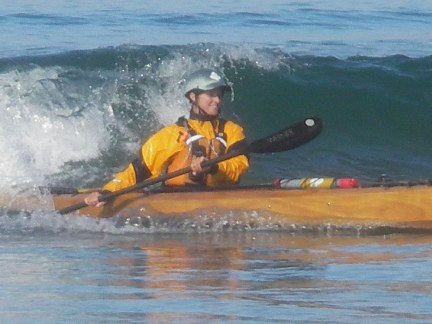
Sunday, May 01, 2005
Unplanned Road Adventures
A few miles inland from the Baja Pacific coast lies a broad, windblown mesa. Highway 1 shoots across it in a straight line north, passing a military checkpoint. Six or seven scattered half-built concrete houses huddle in a forgotten community near the checkpoint. Pulled off in front of the houses sits a blue truck with 5 kayaks on top, the hood up, and one forlorn traveler sitting against the tire in the shade.
You may recognize this traveler from some previous adventures. It is me. As is usually the case, I am trying to convince myself that things aren't as bad as they seem.I was innocently driving up the hill from El Rosario, pushed the clutch to shift into 5th, and nothing happened. The clutch wouldn't depress. I coasted onto the dirt road in front of the huddle of hollow gray houses, and tried to think clearly.
Fluid? Check.
Fuses? Well, I guess that had been the problem with my reverse lights. Otherwise, Check.
Connections under the hood? Check.
Well, hmmm. Maybe I just need to push harder. CRACK! I break the rod which the pedal pushes through the firewall into the master cylinder. Now I know I'm sunk.I drink some water, eat some food, and try to think more clearly. Whatever the original problem is, I know I can't fix the secondary one myself.
So I look up "clutch" in my Spanish-English dictionary. "Embrague" This enables me to 1) curse at it in the appropriate language (as in `pinche embrague'), which cements it in my mind so I can 2) talk to a mechanic if I can find one.
I crawl underneath and discover that the hydraulic hose which is supposed to connect into the transmission doesn't connect to anything. Problem. Armed with information, but fearing a lack of locally available parts, I wander the potholed dirt streets to a house with laundry fluttering on a line in the wind. After some introduction, the occupants determine that I speak enough Spanish for them to be able to help me. Carla, a woman about my age, offers to drive me to the mehanics down in El Rosario, when her mother suggests the telephone. There is no phone book, so Carla calls the operator, who connects her. "What's the problem," she asks me."El embrague," I confidently declare.She looks puzzled but repeats it into the phone, then shrugs, says "I don't know either," and looks at me again.
"The thing to shift the gears," I say, miming the action. She relays this information and then repeats, "Oh, el clutch!"The mechanics say they'll be there right away. I walk back to my truck to wait.Mexican hospitality exists in inverse proportions to Mexican punctuality. An hour or so later, Carla drives up and says get in, we'll go look for them. I ride down the hill with her and learn a few things about the neighborhood. The houses on the mesa were built after some horrible flooding on the river by El Rosario, but people gave up and moved back to their homes in town when the floods were not so persistant as they feared. Land is cheap, and there are no building codes, so a house only really costs the materials and your labor to stack the cinder blocks. Easy come, easy go. Carla lives on the mesa with her parents, her husband and their 2-year old daughter, her brother, sister-in-law and their son, and a young man with a drooling smile and a crooked shock of short black hair, whose connection I never did figure out. The men work in seafood processing or at the gas station in town.
We follow a dirt road maze until it ends at a pile of overturned dusty cars, and Carla says we're here. If this were not omen enough, we find that the mechanics, Andre and Andre, one big and one skinny, are working on the pickup they intended to drive to see me.It's not as bad as it looks, I remind myself. Their shop was typical of rural Baja: a dirt yard with oil stains on the ground. Some shops have trees from whose branches hang whole engines. Some have holes in the ground for getting under vehicles. This one just has a handful of tools tossed in the back of a white truck, and two creative, determined and greasy men named Andre.
They get the truck running and follow us up to my lonely rig on the mesa. Under the dash, I show skinny Andre the broken rod. He uses my tools, which are much more comprehensive than his, and takes apart a few things that were never meant to be taken apart, much less reused. Eventually he pulls out two pieces of rod, one end plastic and one end metal. Big Andre turns them over in his hand and butts them together, saying to me "Chickle," as in Chicklets gum. I groan and shake my head. "Duck tape?" I offer. He laughs and nods.Skinny Andre climbs acrobatically out of my truck and says some things to Carla to tell me, but she doesn't know anything about cars and tells him to tell me himself. He says the rod is the problem and he's going to go work on it. I say, no, wait, there's more underneath, and show him the hydraulic line. He agrees that that is a problem as well.
While he's prodding about at things, big Andre and I discuss all the "American" words that have been adopted into Mexican automotive lexicon. Among others, there are clutch, wipers, hood, auto partes, and my favorite, mofle (muffler). Skinny Andre says that they needed to go look for parts, and would return in five minutes. "Dos horas," ammends big Andre. Carla smirks and nods. "Ensenada?" I ask about the location of parts. I considered contacting a friend in the states to bring me down the necessary bits over the weekend, but that seemed excessive and I lacked long distance phone access. I considered hitchhiking to Ensenada for parts myself, but that seemed intimidating."No," says skinny Andre, "Here in El Rosario.""OK, I'll be here," I say cheerfully."Five minutes," says Skinny."Two hours," says Big. And they leave.I go with Carla back to her house, chuckling together about estimations of time in Mexico. "Andre's right," she says, "It'll be two hours. That's what five minutes means." She says she'd known the pair of them all her life.
I pass the time with the family, switching TV channels between a melodramatic hospital soap and soccer. When the soap is over, news of the failing Pope. I find I can understand most of the Spanish. In fact, this is turning into a day of Spanish immersion, beginning at surf camp this morning with Jorge and Jandro's visit, and now incorporating family, automotive, and entertainment contexts. Carla's daughter wakes up and entertains herself and us for a half an hour by playing with mashed potatoes, and even ingesting some.
Eventually when we look out the window, the mechanics are back at my truck, and we walk over. Mexican punctuality also exists in inverse proportions to Mexican ingenuity. The Andres have a complete rod, welded in the middle, and now made entirely of metal, including the eye on the end. I am impressed. The other fitting doesn't work, and they have to work on it overnight. Meanwhile they think it best to move the truck away from the highway especially if I am going to sleep in it.
There is no way their little truck could drag my loaded one over the rough ground, so they intend to drive my truck by starting it in gear. Except that if the clutch isn't depressed, the engine won't start, and the clutch is still broken. No problem for these guys. Little Andre the stunt man gets behind the wheel. Big Andre pulls a rubber covering off a bolt and holds a cresent wrench under the open hood. I am supposed to close the hood when the truck starts moving (after Andre removes all body parts) so Stunt Man can see where he's going. With a few chugs and a few shouts, my truck is on its way, lumbering through the potholes to Carla's house.
I watch a colorful sunset over the mesa with silhouettes of vehicles gliding along Hwy 1 and stopping at the checkpoint. Somehow the experience of traveling feels very foreign to me right now, that on-the-road feeling I was expecting to live with for a few days. I am suddenly here, part of a community, and not part of a flow. Strangely, I don't feel anxious at all. Unplanned adventures can even be pleasant once one looses the expectation to stick to one's original plan.
I eat refried beans and quesadillas with Carla, greet the others as they come home from work, and crawl into my truck out front to read and sleep. The morning's sunrise is as spectacular as it is flat. Soon the sea fog threatens from the west, and a cold wind heralds its arrival. While waiting for Andre and Andre, I putter with the rod they created, and accidently assemble it into the truck. The clips are one-way, so once I stick it through the firewall and into the master cylinder, it's stuck. So I put it on the pedal mechanism, and find it's stuck there as well. Thankfully, I had stuck it in the right way.
Skinny Andre arrives animated with having thought about the clutch all night, wondering how to reassemble it and how to make the hose stick. I solved the first problem already, which he is happy about. He solves the second, and swears by it. "That will last, but fix the rod better when you cross over," he says, "because it may fall off the pedal."
We still need to fix the wiring so I could start the truck, however. The sensor doesn't fit over the welded rod. Big Andre hot wires it again, and I ride while Skinny Andre drives my truck to the electricians. He chatters merrily all the way down the hill. I think he is relieved to have conquered the clutch. We could tell we were at the electricians by the red aluminium Tecate cans resting in gregarious piles in the corners of the yard. "He tips `em back," says Andre. In about 30 seconds, the electrician clips two wires, and the truck will start in gear, out of gear, or anytime you turn the key.
"How much?" I ask. Skinny Andre says, "A hundred for the electrician, and a hundred for each of us."
"Pesos?" I clarify.
"Si."
So, after 19 hours of El Rosario mesa hospitality and about $30 of auto repair, I am on my way again.
Just so you don't think the saga ends here, the next chapter, were it to be written, would bring to life a night and morning, a few days later, in Eugene, OR where I wait in a nearby sports bar and a Salvation Army outlet while the entire clutch is replaced in a much less creative, more expensive manner. Now it should last for at least another five months!
You may recognize this traveler from some previous adventures. It is me. As is usually the case, I am trying to convince myself that things aren't as bad as they seem.I was innocently driving up the hill from El Rosario, pushed the clutch to shift into 5th, and nothing happened. The clutch wouldn't depress. I coasted onto the dirt road in front of the huddle of hollow gray houses, and tried to think clearly.
Fluid? Check.
Fuses? Well, I guess that had been the problem with my reverse lights. Otherwise, Check.
Connections under the hood? Check.
Well, hmmm. Maybe I just need to push harder. CRACK! I break the rod which the pedal pushes through the firewall into the master cylinder. Now I know I'm sunk.I drink some water, eat some food, and try to think more clearly. Whatever the original problem is, I know I can't fix the secondary one myself.
So I look up "clutch" in my Spanish-English dictionary. "Embrague" This enables me to 1) curse at it in the appropriate language (as in `pinche embrague'), which cements it in my mind so I can 2) talk to a mechanic if I can find one.
I crawl underneath and discover that the hydraulic hose which is supposed to connect into the transmission doesn't connect to anything. Problem. Armed with information, but fearing a lack of locally available parts, I wander the potholed dirt streets to a house with laundry fluttering on a line in the wind. After some introduction, the occupants determine that I speak enough Spanish for them to be able to help me. Carla, a woman about my age, offers to drive me to the mehanics down in El Rosario, when her mother suggests the telephone. There is no phone book, so Carla calls the operator, who connects her. "What's the problem," she asks me."El embrague," I confidently declare.She looks puzzled but repeats it into the phone, then shrugs, says "I don't know either," and looks at me again.
"The thing to shift the gears," I say, miming the action. She relays this information and then repeats, "Oh, el clutch!"The mechanics say they'll be there right away. I walk back to my truck to wait.Mexican hospitality exists in inverse proportions to Mexican punctuality. An hour or so later, Carla drives up and says get in, we'll go look for them. I ride down the hill with her and learn a few things about the neighborhood. The houses on the mesa were built after some horrible flooding on the river by El Rosario, but people gave up and moved back to their homes in town when the floods were not so persistant as they feared. Land is cheap, and there are no building codes, so a house only really costs the materials and your labor to stack the cinder blocks. Easy come, easy go. Carla lives on the mesa with her parents, her husband and their 2-year old daughter, her brother, sister-in-law and their son, and a young man with a drooling smile and a crooked shock of short black hair, whose connection I never did figure out. The men work in seafood processing or at the gas station in town.
We follow a dirt road maze until it ends at a pile of overturned dusty cars, and Carla says we're here. If this were not omen enough, we find that the mechanics, Andre and Andre, one big and one skinny, are working on the pickup they intended to drive to see me.It's not as bad as it looks, I remind myself. Their shop was typical of rural Baja: a dirt yard with oil stains on the ground. Some shops have trees from whose branches hang whole engines. Some have holes in the ground for getting under vehicles. This one just has a handful of tools tossed in the back of a white truck, and two creative, determined and greasy men named Andre.
They get the truck running and follow us up to my lonely rig on the mesa. Under the dash, I show skinny Andre the broken rod. He uses my tools, which are much more comprehensive than his, and takes apart a few things that were never meant to be taken apart, much less reused. Eventually he pulls out two pieces of rod, one end plastic and one end metal. Big Andre turns them over in his hand and butts them together, saying to me "Chickle," as in Chicklets gum. I groan and shake my head. "Duck tape?" I offer. He laughs and nods.Skinny Andre climbs acrobatically out of my truck and says some things to Carla to tell me, but she doesn't know anything about cars and tells him to tell me himself. He says the rod is the problem and he's going to go work on it. I say, no, wait, there's more underneath, and show him the hydraulic line. He agrees that that is a problem as well.
While he's prodding about at things, big Andre and I discuss all the "American" words that have been adopted into Mexican automotive lexicon. Among others, there are clutch, wipers, hood, auto partes, and my favorite, mofle (muffler). Skinny Andre says that they needed to go look for parts, and would return in five minutes. "Dos horas," ammends big Andre. Carla smirks and nods. "Ensenada?" I ask about the location of parts. I considered contacting a friend in the states to bring me down the necessary bits over the weekend, but that seemed excessive and I lacked long distance phone access. I considered hitchhiking to Ensenada for parts myself, but that seemed intimidating."No," says skinny Andre, "Here in El Rosario.""OK, I'll be here," I say cheerfully."Five minutes," says Skinny."Two hours," says Big. And they leave.I go with Carla back to her house, chuckling together about estimations of time in Mexico. "Andre's right," she says, "It'll be two hours. That's what five minutes means." She says she'd known the pair of them all her life.
I pass the time with the family, switching TV channels between a melodramatic hospital soap and soccer. When the soap is over, news of the failing Pope. I find I can understand most of the Spanish. In fact, this is turning into a day of Spanish immersion, beginning at surf camp this morning with Jorge and Jandro's visit, and now incorporating family, automotive, and entertainment contexts. Carla's daughter wakes up and entertains herself and us for a half an hour by playing with mashed potatoes, and even ingesting some.
Eventually when we look out the window, the mechanics are back at my truck, and we walk over. Mexican punctuality also exists in inverse proportions to Mexican ingenuity. The Andres have a complete rod, welded in the middle, and now made entirely of metal, including the eye on the end. I am impressed. The other fitting doesn't work, and they have to work on it overnight. Meanwhile they think it best to move the truck away from the highway especially if I am going to sleep in it.
There is no way their little truck could drag my loaded one over the rough ground, so they intend to drive my truck by starting it in gear. Except that if the clutch isn't depressed, the engine won't start, and the clutch is still broken. No problem for these guys. Little Andre the stunt man gets behind the wheel. Big Andre pulls a rubber covering off a bolt and holds a cresent wrench under the open hood. I am supposed to close the hood when the truck starts moving (after Andre removes all body parts) so Stunt Man can see where he's going. With a few chugs and a few shouts, my truck is on its way, lumbering through the potholes to Carla's house.
I watch a colorful sunset over the mesa with silhouettes of vehicles gliding along Hwy 1 and stopping at the checkpoint. Somehow the experience of traveling feels very foreign to me right now, that on-the-road feeling I was expecting to live with for a few days. I am suddenly here, part of a community, and not part of a flow. Strangely, I don't feel anxious at all. Unplanned adventures can even be pleasant once one looses the expectation to stick to one's original plan.
I eat refried beans and quesadillas with Carla, greet the others as they come home from work, and crawl into my truck out front to read and sleep. The morning's sunrise is as spectacular as it is flat. Soon the sea fog threatens from the west, and a cold wind heralds its arrival. While waiting for Andre and Andre, I putter with the rod they created, and accidently assemble it into the truck. The clips are one-way, so once I stick it through the firewall and into the master cylinder, it's stuck. So I put it on the pedal mechanism, and find it's stuck there as well. Thankfully, I had stuck it in the right way.
Skinny Andre arrives animated with having thought about the clutch all night, wondering how to reassemble it and how to make the hose stick. I solved the first problem already, which he is happy about. He solves the second, and swears by it. "That will last, but fix the rod better when you cross over," he says, "because it may fall off the pedal."
We still need to fix the wiring so I could start the truck, however. The sensor doesn't fit over the welded rod. Big Andre hot wires it again, and I ride while Skinny Andre drives my truck to the electricians. He chatters merrily all the way down the hill. I think he is relieved to have conquered the clutch. We could tell we were at the electricians by the red aluminium Tecate cans resting in gregarious piles in the corners of the yard. "He tips `em back," says Andre. In about 30 seconds, the electrician clips two wires, and the truck will start in gear, out of gear, or anytime you turn the key.
"How much?" I ask. Skinny Andre says, "A hundred for the electrician, and a hundred for each of us."
"Pesos?" I clarify.
"Si."
So, after 19 hours of El Rosario mesa hospitality and about $30 of auto repair, I am on my way again.
Just so you don't think the saga ends here, the next chapter, were it to be written, would bring to life a night and morning, a few days later, in Eugene, OR where I wait in a nearby sports bar and a Salvation Army outlet while the entire clutch is replaced in a much less creative, more expensive manner. Now it should last for at least another five months!

Tuesday, November 23, 2004
Rocks, Water, Action!
The trip began with pure adventure. Even though Dutch BCU coach Axel well outranks me in skills and coaching certifications, I have more experience with Pacific Ocean swell. The importance of this became vividly clear to me when Axel and a Pacific Ocean set found themselves sharing a long archway. The 17’plastic boat he was paddling through the 16’ wide tunnel tossed about like a toy. The yellow bow aimed skyward, then the hull appeared (that would be the bottom), then the whole boat spanned the tunnel without touching the water below it, then just white water, then the bow moving in an undirected, unmanned kind of way, then the deck of the captainless boat. Hmmm, one says to oneself, this is not a promising start to a journey.
When the set subsided, I paddled my little wooden boat back through the tunnel, clipped my short tow on the wallowing banana, and dragged it out the far end to Axel, who was unhurt, but worried about the boat, which was mine. I dumped it out, he climbed in, and we went to a beach nearby to inspect.
Just a flesh wound. A few scrapes in the bow and stern, a few pieces of rock embedded, a little bend in the deck, a little gap between the rim of the day hatch and the deck easily repairable with duct tape and a float bag for security. Some dry clothes for Axel, a few moments of heart rate reduction, and we were back on the water. This became the event that we got the most conversational mileage out of over the next few days. We decided it was a good 5-star rescue precipitated by poor 5-star judgment. Thereafter we conscientiously exercised good 5* judgment.
The Mendocino coast is the domain of rock arches, including one 4-way with the intersection open to the sky. We explored and played, and surfed a little bit in a protected cove. One set wave came in when I was waiting outside the break and Axel was heading out through the impact zone. He said something I didn’t quite catch (perhaps it was in Dutch), and leaned on his paddle with long arms. The wave jacked up and crested, obscuring my view of Axel in the bent banana. Suddenly out the back of the wave, through the green middle of it, a yellow projectile launched, with a yellow-clad passenger bent over the middle and white streams of water flying off. For a moment it was completely airborne in a snapshot of high drama.
After a quick tourist visit to the Redwoods, we and found ourselves on the legendary southern OR coast. This is the secret frolicking ground of sea stacks and offshore rocks. Mazes of them. Playgrounds of them. We used them to full advantage, sometimes riding between as a swell compressed its way through. We stumbled upon sleeping seals, which look like kelp until you’re too close. They float vertically, noses out of the water, bobbing on the swell with eyes closed and nostrils rhythmically flaring and relaxing.
The rest of the Oregon coast was unfriendly as we drove up it, with 13’ swell and high wind. Just across the Columbia in Washington, however, we found the holy grail of sea kayak surfing spots inside the mouth of the river, and covered an awful lot of mileage in 200-yard increments.
Now I’m home, cozying up to computer work and a propane heater, or out puttering in the garden in the short sun of winter, or walking the woods in bright clothes so I’m not mistaken for an elk.
Wednesday, June 23, 2004
fiberglass transplant and cosmetic surgery
June 20, 2004 coastal trip
Location: Manzanita to Cape Falcon & back.
Characters: AJ, Jim, Geoff, Andrew, Ginni, client Chris
Forecast: SW swell 3’, wind W 5K to NW 10 K Tide low in morning
It was a gap I’d studied on several trips, but had never braved it. Swells pushed up against a sloping wall, making a swirling, sloping floor. A passageway turned right, followed the wall, entered a network of caves and rooms open to the sky, and came out at several more accessible places. When the swell receded, it poured over a rock ledge that guarded the entrance. As it began to recede, it made a thick waterfall, which rapidly diminished in volume, exposing the rock, then folded the water back on itself in front of the rock.
Patient observation revealed that there were moments of sufficient calm to paddle through with good timing. The swell was small, tide low, and I was feeling lucky. It appeared that out would be easier than in, so I went around and entered another opening. Jim followed. A set came through, and I calmly surfed a swell along the narrow passageway. At the gap, the water mellowed, and I cruised through on a pool-flat surface.
Jim followed, a moment too late. A swell surged him up towards the wall, and he hesitated for a moment before starting to paddle out. He started to get the waterfall, held his paddle up for the drop, and stalled at the bottom. Over he went, riding the incoming swell upside down back towards the wall.
His paddle came up for a roll, but the kayak was against the wall, and didn’t come up. He came out of the boat, a helmeted head beside a blue hull, and rode the waterfall back over the rock. AJ was closest, so gave Jim his bow and paddled backwards. It took only about 4 strokes to pull Jim and his boat out of the zone. I studied Jim’s face, which didn’t appear to have gotten banged up. We were all wearing helmets, but faces are still vulnerable. He said he was unhurt. AJ dumped the water out of Jim’s’ boat and helped him back in.
It was an exciting time, and the rest of the crew gathered around. Jim, in his irrepressible way, exclaimed, That was fun!
I took his word for it, once Jim was ready to go again, and went back at the gap to settle the score. I mistimed an entry, didn’t like the feel of it, and backed out quickly. In this environment, judgment is the better part of survival. A little more patience, and I cruised in on flat water. Turned around, and got set to exit again.
Perhaps it was impatience, or maybe I just wanted more excitement. A swell pushed in against the wall, and I paddled out onto it, turned, and committed myself to a ride over the falls. The turn took a stroke longer than I’d wanted it to on account of my hips for some reason not being as relaxed as usual and the boat not gracefully edging for the pivot. But committed I was, and I punched out a couple strokes for momentum. Over the drop I rode, bow disappearing into the foam below the rock. I braced on the right just to keep contact with the water. Then, Bam! Solid wooden hull came down on even more solid rock. That was all; momentum and a few more strokes carried me through, and everything was peachy.
I flipped over so Jim could assess damages, and he said all was fine, so onward we went. It turns out the hull was fine for the rest of the day, but it does need some time in boat hospital before the next trip. It may be time to graduate to a plastic boat for coastal adventures.
Here’s to fun rides and no rocks!
Ginni
http://www.shellback.net/ (the gap mentioned above is behind Steve in the second photo on the Shellback homepage)
Location: Manzanita to Cape Falcon & back.
Characters: AJ, Jim, Geoff, Andrew, Ginni, client Chris
Forecast: SW swell 3’, wind W 5K to NW 10 K Tide low in morning
It was a gap I’d studied on several trips, but had never braved it. Swells pushed up against a sloping wall, making a swirling, sloping floor. A passageway turned right, followed the wall, entered a network of caves and rooms open to the sky, and came out at several more accessible places. When the swell receded, it poured over a rock ledge that guarded the entrance. As it began to recede, it made a thick waterfall, which rapidly diminished in volume, exposing the rock, then folded the water back on itself in front of the rock.
Patient observation revealed that there were moments of sufficient calm to paddle through with good timing. The swell was small, tide low, and I was feeling lucky. It appeared that out would be easier than in, so I went around and entered another opening. Jim followed. A set came through, and I calmly surfed a swell along the narrow passageway. At the gap, the water mellowed, and I cruised through on a pool-flat surface.
Jim followed, a moment too late. A swell surged him up towards the wall, and he hesitated for a moment before starting to paddle out. He started to get the waterfall, held his paddle up for the drop, and stalled at the bottom. Over he went, riding the incoming swell upside down back towards the wall.
His paddle came up for a roll, but the kayak was against the wall, and didn’t come up. He came out of the boat, a helmeted head beside a blue hull, and rode the waterfall back over the rock. AJ was closest, so gave Jim his bow and paddled backwards. It took only about 4 strokes to pull Jim and his boat out of the zone. I studied Jim’s face, which didn’t appear to have gotten banged up. We were all wearing helmets, but faces are still vulnerable. He said he was unhurt. AJ dumped the water out of Jim’s’ boat and helped him back in.
It was an exciting time, and the rest of the crew gathered around. Jim, in his irrepressible way, exclaimed, That was fun!
I took his word for it, once Jim was ready to go again, and went back at the gap to settle the score. I mistimed an entry, didn’t like the feel of it, and backed out quickly. In this environment, judgment is the better part of survival. A little more patience, and I cruised in on flat water. Turned around, and got set to exit again.
Perhaps it was impatience, or maybe I just wanted more excitement. A swell pushed in against the wall, and I paddled out onto it, turned, and committed myself to a ride over the falls. The turn took a stroke longer than I’d wanted it to on account of my hips for some reason not being as relaxed as usual and the boat not gracefully edging for the pivot. But committed I was, and I punched out a couple strokes for momentum. Over the drop I rode, bow disappearing into the foam below the rock. I braced on the right just to keep contact with the water. Then, Bam! Solid wooden hull came down on even more solid rock. That was all; momentum and a few more strokes carried me through, and everything was peachy.
I flipped over so Jim could assess damages, and he said all was fine, so onward we went. It turns out the hull was fine for the rest of the day, but it does need some time in boat hospital before the next trip. It may be time to graduate to a plastic boat for coastal adventures.
Here’s to fun rides and no rocks!
Ginni
http://www.shellback.net/ (the gap mentioned above is behind Steve in the second photo on the Shellback homepage)
Tuesday, May 18, 2004
Under Neahkahnie Castle
Oregon Coast
May 15, 2004
We launch at Arch Cape and paddle a couple miles of open coast, past houses nestled in cliff-edge coastal forest. To the west, a flat, wide horizon is curtained here and there with clouds. Birds everywhere--flying in flocks so big they look like weather patterns, floating, frosting the distant rocks. Murres, guillemots, pelicans, cormorants, gulls.
Onward to the cape of complex geology we paddle. Below the spruces are tan stripes of sandstone, or what passes for it from down here. The sandstone rests on a hundred feet or so of black basalt in complicated geometric patterns. At water level in the basalt are caves, pocketing swells and jingling them around like money.
Under Neahkahnie Castle lies a maze of a dungeon, only its underworldly beauty is too great to be called such. Enter the main opening and meet a vertical wall that catches the evening sun reflecting off the water. Along the wall in both directions run tunnels with light at the ends and black floors that undulate with the swells.
One’s first impression upon entering a sea cave is darkness, sound, and constant motion. Sea caves challenge all the senses, although one could argue that anyone paddling into a sea cave has lost all sense. After a few moments, eyes adjust. You adjust and realize that, yes, you are still an air-breathing mammal bobbing on the water. Under a mountain.
Sandy and Tobin exit a nearby opening, and I go through the shorter tunnel to meet them at the mouth of another vaulted room. Looking back through the tunnel, we can see the incoming surge glow emerald, infused by the sun. The next rock-walled enclosure opens to the sky through several portals, and rays of light angle through mist above the churning water.
Back through to the first room we file, then onward through the long tunnel, which is just a few feet higher than an upraised paddle when the swell lifts us. It’s a couple hundred yards long, long enough for several phases of thought to process.
Tobin thinks it feels like a Disney ride, through the tunnel on an undulating track. He starts singing in a small voice, “It’s a Small World After All.” I imagine the native people taking their canoes through here as a feat, having read that they did such things, and, being a water people, I can’t imagine them not. Just then, I think I hear voices in the mountain singing. Very eerie. Silhouettes of two kayaks glide leisurely along in front of me, rising and falling, through the timeless belly of the mountain.
For photos, see http://www.cse.ogi.edu/~walpole/Falcon3.html
May 15, 2004
We launch at Arch Cape and paddle a couple miles of open coast, past houses nestled in cliff-edge coastal forest. To the west, a flat, wide horizon is curtained here and there with clouds. Birds everywhere--flying in flocks so big they look like weather patterns, floating, frosting the distant rocks. Murres, guillemots, pelicans, cormorants, gulls.
Onward to the cape of complex geology we paddle. Below the spruces are tan stripes of sandstone, or what passes for it from down here. The sandstone rests on a hundred feet or so of black basalt in complicated geometric patterns. At water level in the basalt are caves, pocketing swells and jingling them around like money.
Under Neahkahnie Castle lies a maze of a dungeon, only its underworldly beauty is too great to be called such. Enter the main opening and meet a vertical wall that catches the evening sun reflecting off the water. Along the wall in both directions run tunnels with light at the ends and black floors that undulate with the swells.
One’s first impression upon entering a sea cave is darkness, sound, and constant motion. Sea caves challenge all the senses, although one could argue that anyone paddling into a sea cave has lost all sense. After a few moments, eyes adjust. You adjust and realize that, yes, you are still an air-breathing mammal bobbing on the water. Under a mountain.
Sandy and Tobin exit a nearby opening, and I go through the shorter tunnel to meet them at the mouth of another vaulted room. Looking back through the tunnel, we can see the incoming surge glow emerald, infused by the sun. The next rock-walled enclosure opens to the sky through several portals, and rays of light angle through mist above the churning water.
Back through to the first room we file, then onward through the long tunnel, which is just a few feet higher than an upraised paddle when the swell lifts us. It’s a couple hundred yards long, long enough for several phases of thought to process.
Tobin thinks it feels like a Disney ride, through the tunnel on an undulating track. He starts singing in a small voice, “It’s a Small World After All.” I imagine the native people taking their canoes through here as a feat, having read that they did such things, and, being a water people, I can’t imagine them not. Just then, I think I hear voices in the mountain singing. Very eerie. Silhouettes of two kayaks glide leisurely along in front of me, rising and falling, through the timeless belly of the mountain.
For photos, see http://www.cse.ogi.edu/~walpole/Falcon3.html
Monday, April 26, 2004
The Other Side of Oregon
April 26, 2004
The Other Side of Oregon
Cape Lookout is a long, bony finger pointing west and a little south into the Pacific Ocean. The leading edge of the upper plate in a subduction zone, it rises some 300ft straight out of the ocean and bares the geologic stories of many ages in basalt and sandstone. A coastal temperate rainforest grows on its northern slopes, the skeletons of many-limbed crucifixes silhouetted through sun-streaked fog. At its base claws the unsleeping sea.
Some friends from Shellback kayak club—Sam, Jon, Sandy, and I—launch through toothy white surf, the gatekeeper of the ocean, Jon calls it, and into a dynamic world few ever experience.
The reported 5’swell rolls by, dwarfing Sandy in his kayak. Sea feet somehow appear much, much bigger than statute feet. The swell moves on to smash at the base of an offshore rock and send a blanket of white into the air. The water all around is bumpy, unpredictable, ever moving. As if someone were shaking the carpet beneath, but from several directions at once. Foam and sea birds dot the surface.
As we round Cape Lookout’s fingertip, the gray tail of a whale signals high out of the water, like a giant open palm raised in greeting or farewell. It slips gently below the surface. A column of spray shoots skyward, and the barnacled head of another gray whale surfaces for a breath.
South is the Caribbean side of Cape Lookout, sheltered today from direct wave impact. Swells rise and pour off the cliff base where rock is lined with colorful life. Purple and orange sea stars suction themselves to the wall and to each other like haphazard, animated tiles. Tasseled brown kelp grows on rigid, footlong stalks. Six-inch green anemonies bloom prolifically. Anemonies are animals, but their green color comes from tiny plants that live within their cells, bartering photosynthesis work for shelter. Deep inside sea caves, the anemonies are pale.
Our insignificance is magnified inside the giant granddaddy of sea caves, where wave energy ricochets and feeds a rumbling blowhole. Red footed guillemots perched in an overhead crevice whirr like party favors above the gastric churning.
Ah, the dreams we hatched and promises we made to come back to this place as we cruised along the sun warmed, sea bathed wall of life, and ventured into black depths of narrow, unnamed caves, and wove through rock gardens, timing wave surges for rides over little waterfalls. Perhaps the sea will remember even if we in our tragic busy-ness forget.
For photos, see http://www.cse.ogi.edu/~walpole/Lookout2.html
The Other Side of Oregon
Cape Lookout is a long, bony finger pointing west and a little south into the Pacific Ocean. The leading edge of the upper plate in a subduction zone, it rises some 300ft straight out of the ocean and bares the geologic stories of many ages in basalt and sandstone. A coastal temperate rainforest grows on its northern slopes, the skeletons of many-limbed crucifixes silhouetted through sun-streaked fog. At its base claws the unsleeping sea.
Some friends from Shellback kayak club—Sam, Jon, Sandy, and I—launch through toothy white surf, the gatekeeper of the ocean, Jon calls it, and into a dynamic world few ever experience.
The reported 5’swell rolls by, dwarfing Sandy in his kayak. Sea feet somehow appear much, much bigger than statute feet. The swell moves on to smash at the base of an offshore rock and send a blanket of white into the air. The water all around is bumpy, unpredictable, ever moving. As if someone were shaking the carpet beneath, but from several directions at once. Foam and sea birds dot the surface.
As we round Cape Lookout’s fingertip, the gray tail of a whale signals high out of the water, like a giant open palm raised in greeting or farewell. It slips gently below the surface. A column of spray shoots skyward, and the barnacled head of another gray whale surfaces for a breath.
South is the Caribbean side of Cape Lookout, sheltered today from direct wave impact. Swells rise and pour off the cliff base where rock is lined with colorful life. Purple and orange sea stars suction themselves to the wall and to each other like haphazard, animated tiles. Tasseled brown kelp grows on rigid, footlong stalks. Six-inch green anemonies bloom prolifically. Anemonies are animals, but their green color comes from tiny plants that live within their cells, bartering photosynthesis work for shelter. Deep inside sea caves, the anemonies are pale.
Our insignificance is magnified inside the giant granddaddy of sea caves, where wave energy ricochets and feeds a rumbling blowhole. Red footed guillemots perched in an overhead crevice whirr like party favors above the gastric churning.
Ah, the dreams we hatched and promises we made to come back to this place as we cruised along the sun warmed, sea bathed wall of life, and ventured into black depths of narrow, unnamed caves, and wove through rock gardens, timing wave surges for rides over little waterfalls. Perhaps the sea will remember even if we in our tragic busy-ness forget.
For photos, see http://www.cse.ogi.edu/~walpole/Lookout2.html
Friday, March 12, 2004
Open Water Kayak Expedition
Loreto, Mexico; Sea of Cortez
The First Annual Sea of Cortez Open Water Expedition must have been a success because many of the participants are talking about the next one. Personally the trip was rewarding on many levels. I got to share the Baja paddling experience that’s been so important in my life with friends who’ve wanted to see it. I got to run a Baja trip with an instruction component. Watched my handmade Pygmy kayaks carry Elaine and Marty across the Sea of Cortez, sunlight on the wood grain and the exotic rocky greens and tans and pinks of Carmen Island in the background.
Due to some last-minute cancellations, we had space for a Mexican guide-in-training to join us. I met David earlier this winter. He had worked just two days for Villas de Loreto before he joined us for a skill-building day for Mexican guides, and he quickly distinguished himself with his enthusiasm and skill. That day I told Villas they had a keeper.
He proved me right during this last trip. For sheer strength and speed, nobody in our group could touch him. Even in a heavier, slower boat, David could out-sprint any of us, including AJ. For personality, he was a winner. When not helping in the kitchen, he was studying his English, and involving guests in the process. Pre-dinner time turned into informal Spanish/English language classes, at times turning riotous as surprising things were slowly communicated, then verified. Like David’s other job as a body builder and dancer, alongside his role as father of a 2-year old. All at the ripe old age of 21.
David was an asset, too, in encouraging us to visit the old salt pond village on Carmen Island. Two of his friends caretake the place now, which is used occasionally used as a resort. From the 1920s till about 30 years ago, the salt works provided an economic basis more important to Loreto than fishing is today, according to David. Narrow gauge rails carried salt to a barge, which brought it to a ship waiting offshore in the narrow bay. A rusty, barnacled shipwreck lies there still.
The village is a study in irony and juxtaposition. In front of the mechanical repair shop, with its sign intact, sit two tractors filled with dirt and made into cactus planters. One has a flat tire. The old school house is now filled with plastic kayaks for resort users. Turkey vultures pose atop rusty metal poles that once held basketball hoops.
Walls of some buildings were constructed of stone, with coral in the gaps. Other buildings are composed entirely of mortared coral blocks, like lumpy white bricks. In front of a crumbling wall, an orange desert mallow blooms. At the base of a distant hill lies a cemetery where, David tells us, most of the graves belong to children who didn’t make it on this harsh island with its minimal medical care. While he was camping on a nearby point, he thought he saw their ghosts wandering along the sandy beach. He lingers a moment longer than the rest of us in the tiny whitewashed church, the only one of the old buildings apparently kept up, and crosses himself before leaving, perhaps thinking of the children.
The sea gods treated us to a tailwind one day. Our motley little fleet of mismatched kayaks bobbed along down the swell. All together we were ten boats and eleven people: Two wooden Pygmy kayaks; two plastic Tempests, a red, and a yellow; AJ’s yellow and lime fiberglass Tempest, Jim’s orange and yellow Assategue, and four geriatric but willing Seda boats rented from Villas de Loreto, including the Beluga, a white double. Paddles were about as matched as boats, and included a couple of Greenland sticks among the spectrum of big-bladed tools. Paddling styles varied, but increased in efficiency throughout the week. A warmth grew inside as I looked frequently over our crew. From the lead, I monitored our speed and spread, looked for signs of struggle in the rear, assessed the peripheral awareness of one drifting off towards the horizon, and visited with Julie, in front of me in the Beluga. Island silhouettes parted sea from sky, Monserrate to the south and Santa Catalina off to the east. The white marine fossil layer of Carmen’s southern tip glided quickly past the subtle hues of Sierra la Giganta’s steep slopes to the west, and all was well with the world.
Such is the guiding life. My trips in the Sea of Cortez are over for the season, and I head north slowly, hoping to savor some waves along the way. For those who are interested, the Second Annual Sea of Cortez Open Water Expedition is shaping up to be an 8-day adventure about the second week of March 2005, with an eight-mile crossing on the route.
The First Annual Sea of Cortez Open Water Expedition must have been a success because many of the participants are talking about the next one. Personally the trip was rewarding on many levels. I got to share the Baja paddling experience that’s been so important in my life with friends who’ve wanted to see it. I got to run a Baja trip with an instruction component. Watched my handmade Pygmy kayaks carry Elaine and Marty across the Sea of Cortez, sunlight on the wood grain and the exotic rocky greens and tans and pinks of Carmen Island in the background.
Due to some last-minute cancellations, we had space for a Mexican guide-in-training to join us. I met David earlier this winter. He had worked just two days for Villas de Loreto before he joined us for a skill-building day for Mexican guides, and he quickly distinguished himself with his enthusiasm and skill. That day I told Villas they had a keeper.
He proved me right during this last trip. For sheer strength and speed, nobody in our group could touch him. Even in a heavier, slower boat, David could out-sprint any of us, including AJ. For personality, he was a winner. When not helping in the kitchen, he was studying his English, and involving guests in the process. Pre-dinner time turned into informal Spanish/English language classes, at times turning riotous as surprising things were slowly communicated, then verified. Like David’s other job as a body builder and dancer, alongside his role as father of a 2-year old. All at the ripe old age of 21.
David was an asset, too, in encouraging us to visit the old salt pond village on Carmen Island. Two of his friends caretake the place now, which is used occasionally used as a resort. From the 1920s till about 30 years ago, the salt works provided an economic basis more important to Loreto than fishing is today, according to David. Narrow gauge rails carried salt to a barge, which brought it to a ship waiting offshore in the narrow bay. A rusty, barnacled shipwreck lies there still.
The village is a study in irony and juxtaposition. In front of the mechanical repair shop, with its sign intact, sit two tractors filled with dirt and made into cactus planters. One has a flat tire. The old school house is now filled with plastic kayaks for resort users. Turkey vultures pose atop rusty metal poles that once held basketball hoops.
Walls of some buildings were constructed of stone, with coral in the gaps. Other buildings are composed entirely of mortared coral blocks, like lumpy white bricks. In front of a crumbling wall, an orange desert mallow blooms. At the base of a distant hill lies a cemetery where, David tells us, most of the graves belong to children who didn’t make it on this harsh island with its minimal medical care. While he was camping on a nearby point, he thought he saw their ghosts wandering along the sandy beach. He lingers a moment longer than the rest of us in the tiny whitewashed church, the only one of the old buildings apparently kept up, and crosses himself before leaving, perhaps thinking of the children.
The sea gods treated us to a tailwind one day. Our motley little fleet of mismatched kayaks bobbed along down the swell. All together we were ten boats and eleven people: Two wooden Pygmy kayaks; two plastic Tempests, a red, and a yellow; AJ’s yellow and lime fiberglass Tempest, Jim’s orange and yellow Assategue, and four geriatric but willing Seda boats rented from Villas de Loreto, including the Beluga, a white double. Paddles were about as matched as boats, and included a couple of Greenland sticks among the spectrum of big-bladed tools. Paddling styles varied, but increased in efficiency throughout the week. A warmth grew inside as I looked frequently over our crew. From the lead, I monitored our speed and spread, looked for signs of struggle in the rear, assessed the peripheral awareness of one drifting off towards the horizon, and visited with Julie, in front of me in the Beluga. Island silhouettes parted sea from sky, Monserrate to the south and Santa Catalina off to the east. The white marine fossil layer of Carmen’s southern tip glided quickly past the subtle hues of Sierra la Giganta’s steep slopes to the west, and all was well with the world.
Such is the guiding life. My trips in the Sea of Cortez are over for the season, and I head north slowly, hoping to savor some waves along the way. For those who are interested, the Second Annual Sea of Cortez Open Water Expedition is shaping up to be an 8-day adventure about the second week of March 2005, with an eight-mile crossing on the route.
Saturday, February 21, 2004
In the Stars
Loreto, Mexico
Baja kayak trips. It's about the improbable landscape where desert touches ocean. It's about the colorful burst of fish around a rock, brushed with dancing sunlight. Or the miniscule leaf of a palo verde tree. But it's also about the people whom fate has brought together for the week.
When Frank and Katie first met, he thought she was too tomboy, and she plain didn't like him. That was in Georgia almost 60 years ago. This week in Baja, on a desert island, they celebrated 55 years of marriage. Demonstrating respect and tender affection for each other, and a healthy sense of fun, they were a brisk breeze of inspiration to this independent kayak guide.
Lee died in the hospital once, but came back determined to enjoy life. Whatever he and his wife Suzy wanted to do, they would, before it was too late for real. This kayak trip was evidence.
Simon, from the UK via Uganda, was trying to decide what to do next in life, and came close to cancelling his Australia plans to travel slowly up the Baja because he'd fallen in love... with the desert.
All in all, it was an uninhibited group of individuals. The Heavenly Body Exercise demonstrated this well. Not quite what you think, this exercise is a 3-D interactive model of the solar system designed to illustrate the phenomena we see in space in a down-to-earth way.
Venus the Godess of Love (Lee) boogeyed down with fleet-footed Murcury (Dick) around Her Tremendous Radiance, Karen the sun. Simon spun on his tilted axis 365 times per orbit, closely attended by Mark, who'd earned his position by dropping his drawers at us from the lighthouse tower the night before.
The solar system stumbled along in its free-form way when from the far reaches of space came a passing comet, James, from another kayak camp seeking cell phone reception. He had a close brush with Jupiter, the large, gaseous one, played by Linda the Petite, before a dinner call shattered the fine balance of physics with a greater gravity.
Baja kayak trips. It's about the improbable landscape where desert touches ocean. It's about the colorful burst of fish around a rock, brushed with dancing sunlight. Or the miniscule leaf of a palo verde tree. But it's also about the people whom fate has brought together for the week.
When Frank and Katie first met, he thought she was too tomboy, and she plain didn't like him. That was in Georgia almost 60 years ago. This week in Baja, on a desert island, they celebrated 55 years of marriage. Demonstrating respect and tender affection for each other, and a healthy sense of fun, they were a brisk breeze of inspiration to this independent kayak guide.
Lee died in the hospital once, but came back determined to enjoy life. Whatever he and his wife Suzy wanted to do, they would, before it was too late for real. This kayak trip was evidence.
Simon, from the UK via Uganda, was trying to decide what to do next in life, and came close to cancelling his Australia plans to travel slowly up the Baja because he'd fallen in love... with the desert.
All in all, it was an uninhibited group of individuals. The Heavenly Body Exercise demonstrated this well. Not quite what you think, this exercise is a 3-D interactive model of the solar system designed to illustrate the phenomena we see in space in a down-to-earth way.
Venus the Godess of Love (Lee) boogeyed down with fleet-footed Murcury (Dick) around Her Tremendous Radiance, Karen the sun. Simon spun on his tilted axis 365 times per orbit, closely attended by Mark, who'd earned his position by dropping his drawers at us from the lighthouse tower the night before.
The solar system stumbled along in its free-form way when from the far reaches of space came a passing comet, James, from another kayak camp seeking cell phone reception. He had a close brush with Jupiter, the large, gaseous one, played by Linda the Petite, before a dinner call shattered the fine balance of physics with a greater gravity.
Subscribe to:
Posts (Atom)

